Van Doesburg & Hungary's Avant-Garde: A 1920s Art Network
Miguel Fernández ·
Listen to this article~3 min
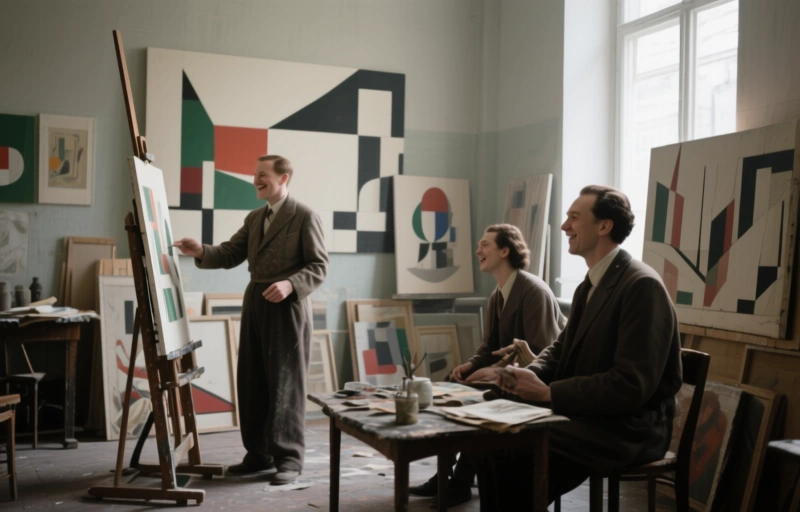
Explore the hidden 1920s network between Dutch artist Theo van Doesburg (De Stijl) and Hungary's avant-garde circle around Lajos Kassák (Ma). Discover how letters and shared ideas shaped modern art across borders.
Let's talk about something that doesn't get enough attention—the hidden conversations between artists that changed everything. In the early 1920s, while most of Europe was still catching its breath after the Great War, a quiet revolution was happening in studios and editorial offices. It wasn't about big public manifestos or museum shows. It was about letters, shared ideas, and a network of creators stretching across borders.
### The Key Players in This Artistic Exchange
At the center of this story are two men and two magazines. On one side, you had Theo van Doesburg in the Netherlands. He wasn't just a painter; he was the driving force behind *De Stijl* (The Style), that iconic journal pushing pure abstraction and new visual languages. Think of him as a connector, always looking for fellow travelers.
On the other side, in Budapest, was Lajos Kassák and his circle. Their magazine was called *Ma* (Today), and it pulsed with the same restless energy. Kassák gathered a remarkable group: Sándor Bortnyik, László Moholy-Nagy (who'd later make waves at the Bauhaus), László Péri, and others. They were hungry for what was happening beyond Hungary's borders.
### How Did These Worlds Connect?
That's the fascinating part. This wasn't a formal alliance. It was built through personal correspondence, exchanged publications, and mutual admiration. Van Doesburg saw something vital in the work coming out of Hungary. The Hungarian artists, in turn, saw *De Stijl* as a beacon of the international modern movement they wanted to join.
They shared a belief that art had to be rebuilt from the ground up. Old forms were tied to old worlds. Their dialogue covered everything:
- The role of geometry and abstraction
- The relationship between painting, sculpture, and architecture
- How art could function in a new, modern society
Archival letters show this wasn't just polite chatter. It was a serious exchange of theories, critiques, and encouragement. These documents, now held at the Kassák Museum in Budapest and the RKD in The Hague, let us trace the lines of this network.
### Why This Little-Known History Matters Today
You might wonder why we should care about some letters from a century ago. Here's the thing—it shows us how ideas actually move. Major art movements don't just appear fully formed. They're woven together by individuals reaching out, often against political and logistical odds.
In the 1920s, sending a magazine from Amsterdam to Budapest wasn't as simple as clicking a link. It took effort and intention. This micro-history reminds us that behind every '-ism' are real people making connections. For professionals and enthusiasts today, it underscores a timeless truth: creativity thrives on conversation, especially across cultures.
The legacy of this exchange is subtle but real. You can see its echoes in the later work of Moholy-Nagy. You can feel its spirit in the internationalist dream of modernism itself. It's a testament to the power of a simple idea shared between curious minds.