Van Doesburg's Hungarian Connection: Avant-Garde Networks
Miguel Fernández ·
Listen to this article~4 min
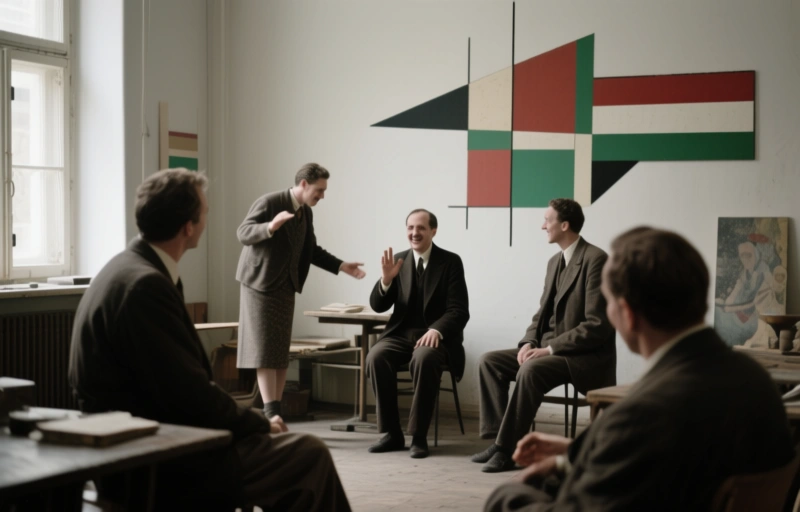
Explore the fascinating connection between Dutch artist Theo van Doesburg and Hungary's avant-garde in the 1920s. Discover how their cross-border dialogue shaped modern art through letters, publications, and shared vision.
Let's talk about something that doesn't get enough attention in art history circles. The quiet conversations between artists that changed everything. I'm thinking about the 1920s, that wild period after World War I when everything felt possible. Artists weren't just working in their studios—they were writing letters, traveling, and building networks across borders.
One of the most fascinating connections? The link between Dutch artist Theo van Doesburg and the Hungarian avant-garde. It's a story about more than just art—it's about how ideas travel.
### Who Was Theo van Doesburg?
You've probably heard of De Stijl, that radical Dutch art movement. Clean lines, primary colors, pure abstraction. Van Doesburg wasn't just a painter—he was the editor of *De Stijl* magazine, which became a hub for avant-garde thinking across Europe. Think of him as a connector, someone who brought people together through his publication and his travels.
He believed art should be universal, breaking down national boundaries. And he put that belief into practice by reaching out to artists everywhere.
### The Hungarian Scene: More Than Just Moholy-Nagy
When we think Hungarian modernists, László Moholy-Nagy usually comes to mind first. But there was a whole scene buzzing in Budapest, centered around another magazine called *Ma* (which means "Today").
Lajos Kassák edited *Ma*, and around him gathered artists like Sándor Bortnyik and László Péri. They were exploring similar territory to the De Stijl group—abstraction, new visual languages, art as social force. But they were doing it from a different cultural perspective, in a country that had just experienced revolution and counter-revolution.
### How These Worlds Connected
Here's where it gets interesting. Van Doesburg didn't just admire the Hungarian artists from afar. He actively engaged with them:
- He published Hungarian artists in *De Stijl*
- He corresponded with Kassák about artistic theory
- He helped introduce Hungarian work to Western European audiences
- He visited Budapest and met with these artists personally
These weren't casual contacts. They were deep, substantive exchanges about what art could be in the modern world. Both groups believed art should transform society, not just decorate it.
### What We Learn From Their Correspondence
Reading their letters (preserved in archives in Budapest and The Hague), you get a sense of shared purpose. They debated everything from color theory to political engagement. One thing that stands out? How much they respected each other's different approaches.
Van Doesburg wrote to Kassák in 1922: "Your work shows a different path to the same destination." That's the kind of open-mindedness we could use more of today.
### Why This History Matters Now
We live in a connected world, but sometimes our artistic conversations feel more fragmented than ever. Looking back at these 1920s networks reminds us that cross-pollination creates the most interesting art. When ideas travel, they transform.
The Hungarian-Dutch connection shows how avant-garde movements weren't isolated phenomena. They were conversations happening across continents, through magazines, letters, and personal meetings. The artists involved weren't just making objects—they were building a new way of seeing.
### The Legacy of These Exchanges
What came of all this networking? For one thing, it helped spread constructivist ideas throughout Europe. It also created personal bonds that lasted years—Moholy-Nagy would later teach at the Bauhaus, continuing the conversation Van Doesburg helped start.
More importantly, it created a model for how artists can collaborate across distances and differences. They didn't always agree, but they listened to each other. They published each other's work. They created what we'd now call a transnational artistic community.
So next time you look at a De Stijl painting or a Hungarian constructivist work, remember—these weren't created in isolation. They were part of a conversation that stretched from Amsterdam to Budapest, a dialogue about what art could become in the modern age. And that conversation still has things to teach us about creativity, connection, and crossing boundaries.