Van Doesburg & The Hungarian Avant-Garde Connection
Miguel Fernández ·
Listen to this article~4 min
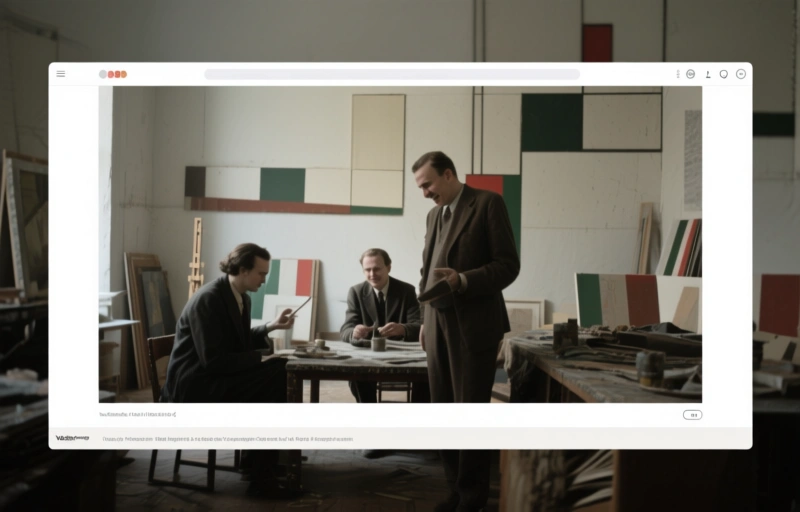
Explore the hidden network between Dutch artist Theo van Doesburg (De Stijl) and Hungary's avant-garde Ma circle in the 1920s. Discover how letters and ideas shaped modern art across Europe.
Let's talk about a fascinating, almost hidden, chapter in art history. It's the story of how ideas traveled across a Europe still recovering from war, connecting creative minds who were determined to reinvent everything. We're focusing on the first half of the 1920s, a time of incredible artistic ferment.
At the center of our story is Theo van Doesburg. You might know him as the relentless engine behind *De Stijl* (The Style), that Dutch movement obsessed with pure abstraction, primary colors, and straight lines. He wasn't just a painter; he was a networker, an editor, a theorist constantly reaching out.
### The Hungarian Counterpart: The *Ma* Circle
Across the continent, in Budapest, a parallel revolution was brewing. A group of radical artists and writers had coalesced around their own journal, called *Ma* (Today). Think of *Ma* as the Hungarian heartbeat of the avant-garde. Its leader was Lajos Kassák, a poet and artist with a vision as bold as van Doesburg's.
The *Ma* group included future giants. Sándor Bortnyik was there, experimenting with bold graphic design. A young László Moholy-Nagy, who would later become a Bauhaus legend, was part of this scene. So was László Péri, exploring new forms in sculpture. They were all asking the same fundamental questions as the *De Stijl* group, just in a different language and a different political climate.
So, what happened when these two powerhouses of thought made contact? It wasn't just a polite exchange of letters. This was the collision of two artistic universes, and it sparked something new.
### Tracing the Connections Through Archives
To understand this network, we have to dig into the archives. The personal papers of Lajos Kassák, held at the Kassák Museum in Budapest, tell one side of the story. Theo van Doesburg's estate, preserved at the RKD – Netherlands Institute for Art History in The Hague, tells the other.
Piecing these documents together is like detective work. We find letters debating aesthetics, sketches shared for feedback, and discussions about publishing each other's work. This wasn't a one-way street. It was a true dialogue. The Hungarians weren't just students; they were contributors, critics, and collaborators in a pan-European conversation about the future of art.
- **Shared Publications:** Works by Kassák and others appeared in *De Stijl*, introducing Hungarian ideas to a Western European audience.
- **Theoretical Exchange:** They debated the role of art in society, the value of abstraction, and the relationship between art and technology.
- **Personal Networks:** These connections often led to further introductions, weaving a tighter web across the continent.
This micro-history shows us that the avant-garde wasn't a series of isolated movements. It was a living, breathing network. Artists in Budapest were reading journals from Holland, and ideas formulated in a Paris cafe could influence a manifesto written in a Berlin studio. The contact between van Doesburg and the *Ma* artists is a perfect case study—a snapshot of how modernism was built, one connection at a time.
It reminds us that behind every big '-ism,' there are people writing letters, sharing dreams, and arguing over coffee. Their legacy isn't just in the paintings on the wall, but in the very idea that art could be a transnational conversation, pushing beyond old borders to create something entirely new.