Van Doesburg & The Hungarian Avant-Garde: A 1920s Connection
Miguel Fernández ·
Listen to this article~4 min
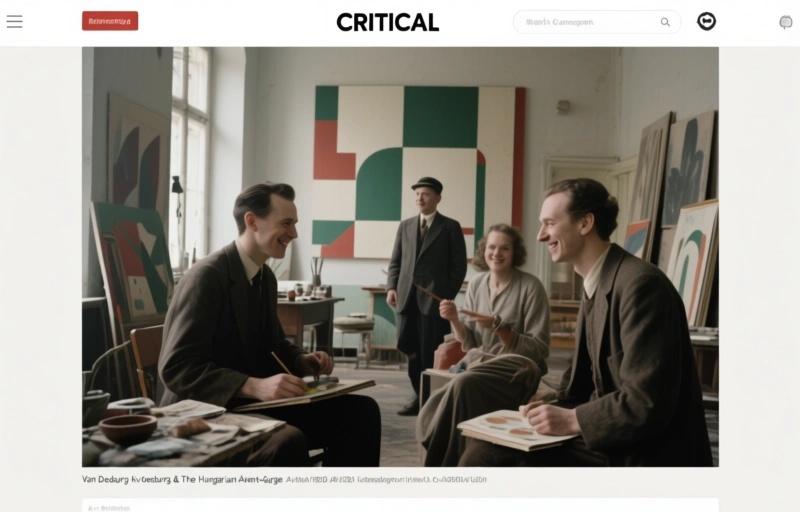
Explore the 1920s connection between Dutch artist Theo van Doesburg and Hungary's avant-garde circle around Lajos Kassák. Discover how their exchange shaped modern art.
Let's talk about art history, but not the boring textbook kind. I want to tell you a story about connections, about how ideas travel across borders. It's about a Dutch artist and a group of Hungarians who, for a brief moment in the 1920s, sparked something special. This isn't just a dry analysis—it's a look at the human networks that fueled modern art.
We're focusing on Theo van Doesburg. You might know him as the driving force behind *De Stijl* (The Style), that iconic Dutch movement with its bold lines and primary colors. But his influence stretched far beyond the Netherlands. In the early 1920s, his path crossed with a vibrant group of Hungarian avant-garde artists centered around the periodical *Ma* (Today).
### The Key Players in Budapest
This wasn't a one-man show. The Hungarian side was packed with talent, each artist a powerhouse in their own right. Van Doesburg connected with:
- **Lajos Kassák:** The poet, painter, and editor who was essentially the ringleader of *Ma*. He was the central node in this network.
- **Sándor Bortnyik:** A painter and graphic designer whose work pulsed with modernist energy.
- **László Moholy-Nagy:** A name that would later become legendary at the Bauhaus. Even in these early days, his innovative spirit was clear.
- **László Péri:** A constructivist sculptor exploring new forms and materials.
Think of it like a creative summit. These weren't just pen pals; they were exchanging ideas, publications, and visions for what art could be in a post-war world.
### How We Know This Story
So, how do we piece together these interactions from a century ago? It comes down to digging through archives. The real meat of this story comes from primary sources—letters, unpublished writings, and personal documents.
Researchers have spent hours in two key places: the Kassák Museum in Budapest, which holds Lajos Kassák's estate, and the RKD – Netherlands Institute for Art History in The Hague, home to Van Doesburg's archives. It's in these collections that you find the handwritten notes, the sketches in margins, and the personal correspondence that reveal the true depth of these relationships. It's micro-history at its best, focusing on the specific threads that made up the larger tapestry of the European avant-garde.
As one scholar noted, tracing these networks shows us that modernism wasn't a series of isolated movements, but a constant, buzzing conversation.
### Why This Connection Mattered
This wasn't just a polite exchange of magazines. This contact had real impact. For the Hungarian artists, connection with an established figure like Van Doesburg and the *De Stijl* network was a vital link to the wider European scene. It was a form of validation and a channel for their ideas to reach a broader audience.
For Van Doesburg, engaging with the energetic *Ma* group kept his own practice and thinking fresh. It was a two-way street of influence. They debated, they critiqued, and they inspired each other. This period in the early 1920s was a hotbed for experimental ideas about abstraction, constructivism, and the role of art in society. These cross-border dialogues were the fuel.
### The Legacy of a Network
What's fascinating is how these connections rippled forward. The ideas exchanged in letters between Budapest and the Netherlands didn't just vanish. They influenced the work these artists produced. They shaped the pedagogical approaches of figures like Moholy-Nagy, who would go on to teach a generation. They reinforced the idea that the avant-garde was, by its nature, international.
Looking back, this story reminds us that art movements are never monolithic. They're living things, built on personal relationships, chance meetings, and the relentless sharing of ideas across any barrier. The connection between Theo van Doesburg and the Hungarian avant-garde is a perfect, glittering example of that human network in action. It's a reminder that sometimes, the most radical art grows from simple conversation.