Van Doesburg & the Hungarian Avant-Garde: A 1920s Connection
Miguel Fernández ·
Listen to this article~4 min
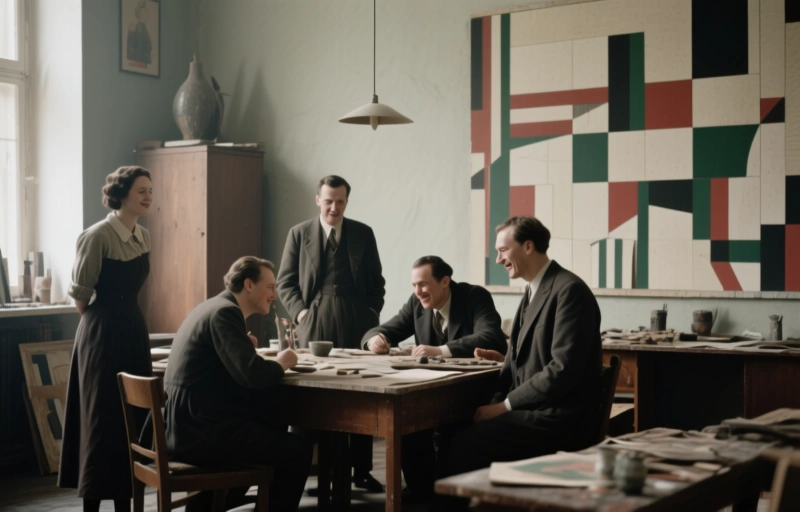
Explore the 1920s connection between Dutch artist Theo van Doesburg (De Stijl) and Hungary's avant-garde circle around Lajos Kassák (Ma), including Moholy-Nagy. Discover how this cross-border dialogue shaped modern art.
Let's talk about a fascinating moment in art history. It's the early 1920s, and Europe is buzzing with creative energy after the First World War. In the middle of it all, a Dutch artist named Theo van Doesburg starts connecting with a group of radical Hungarian artists. This isn't just a footnote—it's a key story about how avant-garde ideas traveled across borders.
Van Doesburg was the driving force behind *De Stijl* (The Style), that famous Dutch movement focused on pure abstraction, primary colors, and straight lines. Think of those iconic Mondrian paintings. Meanwhile, over in Budapest, artists like Lajos Kassák were publishing their own fiery periodical called *Ma* (Today). They were pushing constructivism and a new, machine-age aesthetic.
### How Did These Artists Connect?
So, how did a Dutch artist and a bunch of Hungarians find each other? It wasn't easy. This was long before the internet or cheap international calls. Connections were made through letters, published journals, and the occasional trip. Van Doesburg was a natural networker, always looking to expand the reach of his ideas. He saw the work coming out of Hungary and recognized a kindred spirit.
He started corresponding with Kassák, the editor of *Ma*. They exchanged publications, debated ideas, and essentially created a trans-European dialogue. This contact wasn't just polite pen-pal stuff. It was a serious exchange of manifestos, artwork, and theories that shaped the direction of modern art.
### The Key Hungarian Players
This story isn't just about two editors. It involves a whole cast of brilliant Hungarian artists who would go on to shape 20th-century art. When you look at the circle around *Ma*, you see some legendary names:
- **Lajos Kassák**: The charismatic leader and editor, a poet and artist who was the central hub for the Hungarian avant-garde.
- **Sándor Bortnyik**: A painter and graphic designer whose work blended constructivism with a unique visual style.
- **László Moholy-Nagy**: Perhaps the most famous of the group, who later taught at the Bauhaus and revolutionized photography and design.
- **László Péri**: A sculptor and painter known for his architectural approach to form.
These artists weren't working in a vacuum. Their contact with van Doesburg and *De Stijl* gave them a crucial link to the wider European scene. It validated their work and opened doors.
### What the Archives Tell Us
We know about this connection today because of painstaking archival work. Researchers have dug through the personal estates of both Kassák and van Doesburg. Kassák's papers are held at the museum dedicated to him in Budapest. Van Doesburg's vast archive is at the Netherlands Institute for Art History in The Hague.
These letters and documents show us the real, human side of art history. They're not just dry theories. You can read the excitement in their words as they discovered each other's work. You can also see the practical discussions about publishing each other's writings and reproducing artworks. It was a collaboration built on mutual respect and a shared vision for a new art.
### Why This Network Mattered
This micro-history of a specific connection tells a much bigger story. The 1920s avant-garde wasn't a series of isolated national movements. It was a vibrant, international network. Artists in Holland, Hungary, Russia, and Germany were all talking to each other, arguing, and inspiring one another.
The contact between van Doesburg and the *Ma* group helped spread constructivist ideas. It influenced everything from painting and sculpture to typography and architecture. When Moholy-Nagy later brought his ideas to the Bauhaus, he was carrying with him the influences of both his Hungarian roots and his Dutch connections.
In a way, these artists were building the first global art community, piece by piece, letter by letter. They proved that radical ideas could jump over political and geographical barriers. Their story reminds us that art thrives on conversation and connection, even—or especially—in turbulent times. It's a lesson that feels just as relevant now as it did a century ago.