Van Doesburg & Hungary's Avant-Garde: A 1920s Art Network
Miguel Fernández ·
Listen to this article~3 min
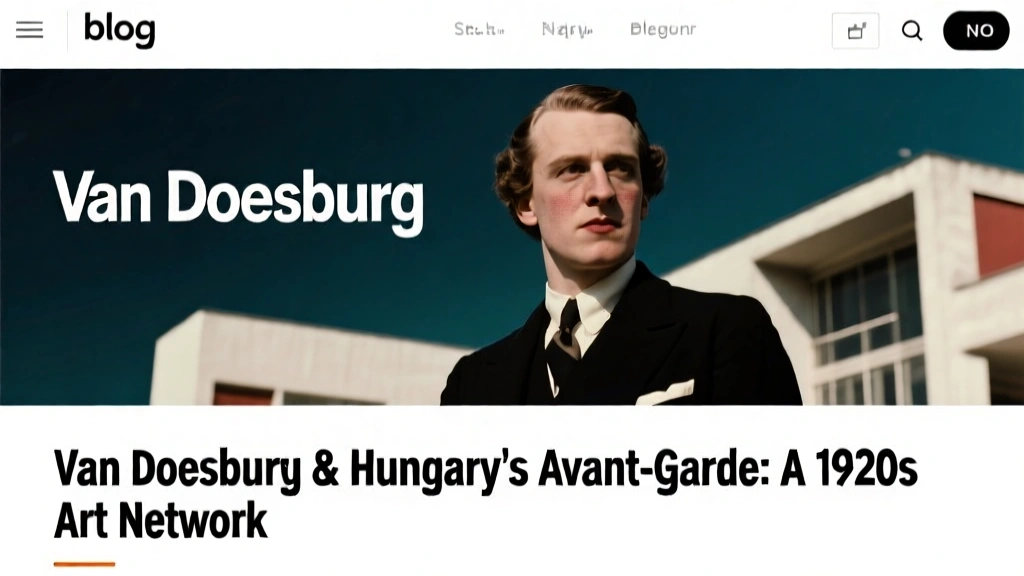
Explore the 1920s connection between Dutch artist Theo van Doesburg (De Stijl) and Hungary's avant-garde circle around the journal Ma. Discover how this network shaped modern art through letters, shared ideas, and a cross-border creative dialogue.
Let's talk about art history, but not the dry, textbook kind. I want to pull you into a specific moment in the 1920s, when creative ideas were zipping across Europe like telegrams. This is the story of a fascinating connection between a Dutch pioneer and a group of Hungarian revolutionaries—not with guns, but with paint, print, and radical design.
We're focusing on Theo van Doesburg. He wasn't just an artist; he was a powerhouse, the driving force behind the influential journal *De Stijl* (The Style). Think clean lines, primary colors, and a bold vision for a new world. Now, shift your gaze to Budapest. There, a vibrant scene was buzzing around the journal *Ma* (Today), led by figures like Lajos Kassák.
### The Bridge Between Two Worlds
So, what happened when these two forces made contact in the early 1920s? It wasn't a single meeting. It was a slow, deliberate building of a network. Van Doesburg, always looking to expand his international reach, saw potential in the Hungarians. Artists like Sándor Bortnyik, László Moholy-Nagy (who'd later make waves at the Bauhaus), and László Péri were pushing boundaries in their own right.
This connection was built on letters, exchanged artworks, and published writings. It was a dialogue. The Hungarians were exposed to the strict geometries of Neoplasticism from Holland. In turn, their own constructivist and activist energies fed back into the wider European conversation. It was a two-way street of inspiration.
### Why This Little-Known Story Matters
You might wonder why we should care about these old letters and journal exchanges. Here's the thing: art movements don't happen in isolation. They're living networks. By tracing these specific links, we see how ideas actually traveled before the internet. We understand that the avant-garde wasn't a monolith; it was a messy, exciting web of personal relationships and shared ambitions.
- **It shows the human side of art history.** Behind every '-ism' are people writing letters, arguing, and supporting each other.
- **It highlights Hungary's crucial role.** Often overlooked, the *Ma* group was a major hub of innovation.
- **It reveals how networks shape culture.** This micro-history gives us a blueprint for how creative communities form and influence each other across borders.
The research for this comes straight from the source—archives. Scholars have dug into the Kassák estate in Budapest and the Van Doesburg papers in The Hague. These primary sources let us piece together the story not from summaries, but from the actual words and works of the artists involved.
As one scholar noted, tracing these connections is like 'mapping the nervous system of modern art.' It shows the vital impulses that connected disparate cities and minds.
In the end, this isn't just a tale about the past. It's a reminder that creativity thrives on connection. The conversations started between van Doesburg and the *Ma* artists over a century ago still echo in how we think about design, abstraction, and the power of a shared vision. Their network, built one letter at a time, helped wire the artistic consciousness of an entire era.