While the geometric rigor and spiritual utopianism of Theo van Doesburg and his Hungarian avant-garde contemporaries like Lajos Kassák and Sándor Bortnyik seem worlds away from the neon spectacle of the Nevada desert, both movements share a foundational belief in art as a transformative force for modern life. The De Stijl and Hungarian Activist artists of the 1920s sought to construct a new visual language—one of pure abstraction, primary colors, and dynamic composition—that would reshape society itself. This ethos of creating immersive, total environments finds a distant, populist echo in the consciously designed sensory overload of the contemporary entertainment capital. Today, the pursuit of a fully synthesized aesthetic experience, where architecture, light, and sound coalesce into a single overwhelming reality, is perhaps most perfectly realized in the curated fantasy worlds of the Las Vegas Strip. For scholars and art lovers tracing this lineage from avant-garde theory to modern practice, understanding how these principles of environmental design have been adapted (and commercialized) offers a fascinating critical lens. Just as van Doesburg's *Counter-Compositions* aimed to generate dynamic energy through diagonal lines, the very cityscape of Las Vegas is engineered to create a perpetual state of visual excitement and kinetic possibility, proving that the avant-garde's dream of a total artwork, or *Gesamtkunstwerk*, took unexpected forms in the 20th century. Exploring this connection reminds us that the boundaries between high art and popular culture are often more permeable than they appear.
Van Doesburg & Hungary's Avant-Garde: A 1920s Art Network
Miguel Fernández ·
Listen to this article~5 min
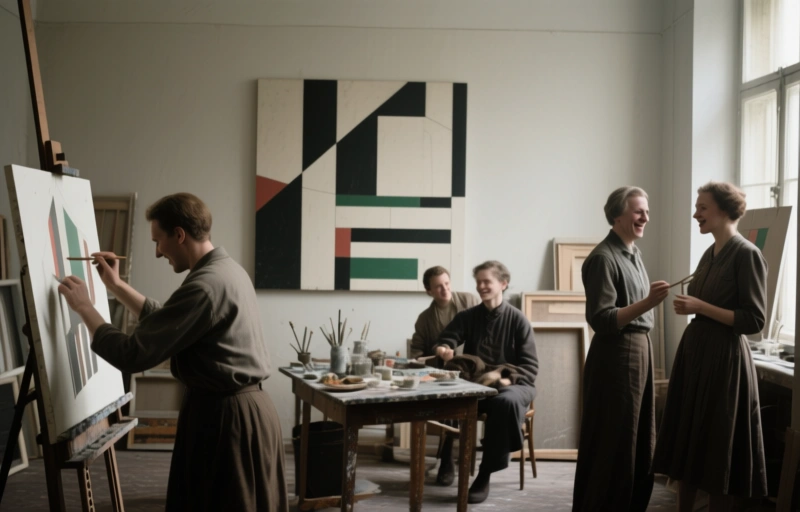
Explore the hidden network between Dutch artist Theo van Doesburg (De Stijl) and Hungary's avant-garde circle around the journal 'Ma' in the 1920s, revealing how cross-border connections shaped modern art.
Let's talk about something that doesn't get enough airtime—the secret handshakes and creative sparks that flew across Europe in the 1920s. I'm talking about the moment when Theo van Doesburg, that powerhouse Dutch artist and editor of *De Stijl*, connected with a fiery group of Hungarian innovators. It's a story of letters, ideas, and a shared hunger to break all the rules.
This wasn't just a casual pen-pal situation. We're looking at a micro-history, a zoomed-in look at how these specific artists built bridges. On one side, you had Van Doesburg, the driving force behind the De Stijl movement with its rigid grids and primary colors. On the other, you had the crew from Budapest, artists like Lajos Kassák, Sándor Bortnyik, and a young László Moholy-Nagy, all buzzing around their own radical journal, *Ma* (which simply means 'Today').
### The Players in a Post-War Scene
Think about the time. Europe was picking up the pieces after the First World War. In that atmosphere, artists weren't just making pretty pictures; they were architects for a new world. They believed art could rebuild society. Van Doesburg was a connector, a networker before the term existed. He didn't see borders; he saw fellow travelers.
The Hungarian group was electric. They were experimenting with everything—constructivism, new typography, abstract forms. Kassák was the charismatic leader, Bortnyik the brilliant designer, and Moholy-Nagy... well, he was on his way to becoming a legend at the Bauhaus. They were all asking the same fundamental question: what does modern art look like, and what is its purpose?
### Tracing the Connections Through Archives
So how do we know all this? The paper trail. Scholars have dug deep into the archives—the Kassák Museum in Budapest and the Netherlands Institute for Art History in The Hague. These aren't just dusty boxes; they're filled with letters, postcards, sketches, and manuscripts that map out a whole hidden network.
These documents show us the 'how.' They reveal:
- The exchange of journals and manifestos
- Discussions about exhibitions and collaborations
- The very personal debates about form, politics, and abstraction
It's one thing to know two groups existed. It's another to see the ink-stained evidence of their dialogue. That's where the real history lives, in the margins of those letters.
### Why This Little Network Mattered
You might wonder why this specific link matters. Here's the thing: art movements don't appear out of thin air. They're conversations. The contact between Van Doesburg and the *Ma* group helped cross-pollinate ideas that shaped 20th-century design. Think about the clean lines, the functionalism, the belief that art and life should merge. Those ideas traveled along these very networks.
As one scholar noted, 'The avant-garde was less a style and more a conversation across continents.' This connection was a vital thread in that larger tapestry. It helped move ideas from the cafes of Budapest to the studios of Weimar and beyond.
In the end, this story reminds us that creativity is rarely a solo act. It's a collective, often messy, and wonderfully human endeavor. The 1920s avant-garde was building a new visual language, and they were doing it together, one letter, one journal, and one radical idea at a time.