Van Doesburg Meets the Hungarian Avant-Garde
Miguel Fernández ·
Listen to this article~5 min
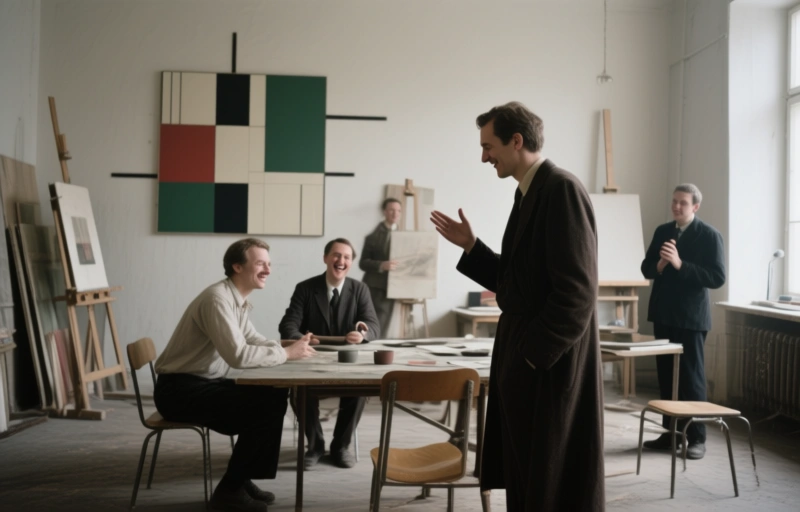
Explore the micro-history of Theo van Doesburg's connection with Hungarian avant-garde artists in the 1920s, based on archival research from Budapest and The Hague.
### The Crossroads of Two Avant-Garde Worlds
Imagine two creative forces colliding in the middle of 1920s Europe. That's exactly what happened when Theo van Doesburg, the driving force behind *De Stijl*, connected with a group of Hungarian artists who were shaking things up with their magazine, *Ma* (meaning "Today"). This wasn't just a meeting of minds—it was a fusion of ideas that would ripple through modern art.
Van Doesburg was a Dutch firebrand. He didn't just paint; he edited, wrote, and organized. His magazine, *De Stijl*, was the bible of a movement that wanted to strip art down to its purest forms: straight lines, primary colors, and a sense of universal harmony. On the other side, the Hungarians—names like Lajos Kassák, Sándor Bortnyik, László Moholy-Nagy, and László Péri—were pushing their own boundaries. They were activists, poets, and designers who used *Ma* to champion a radical, socially engaged art.
What brought them together? A shared belief that art could change the world. But their paths weren't always smooth. This article digs into the archives to show how these two groups influenced each other, clashed, and ultimately shaped the avant-garde landscape.
### A Micro-History of Artistic Exchange
This isn't a broad overview. It's a micro-history—a close, detailed look at specific moments and letters between these artists. I spent time in the archives: the Kassák Museum in Budapest and the RKD—Netherlands Institute for Art History in The Hague. Those dusty folders reveal a lot.
You see, the 1920s were a time of intense networking. Artists traveled, wrote letters, and exchanged ideas across borders. Van Doesburg was a master at this. He toured Europe, giving lectures and building connections. When he met the Hungarian group, something clicked.
- **Shared ideals:** Both groups wanted to break from tradition and create a new, modern art.
- **Different approaches:** *De Stijl* was more about pure abstraction and universal forms. *Ma* was grittier, more political, and open to Dada influences.
- **Personal tensions:** Not everyone got along. Van Doesburg could be domineering, and some Hungarians pushed back.
### Key Figures in the Network
Let's zoom in on a few people who made this exchange happen.
**Theo van Doesburg** was the connector. He saw the Hungarian scene as fertile ground for his ideas. He published their work in *De Stijl* and invited them to contribute. He was always looking for allies.
**Lajos Kassák** was the Hungarian equivalent—a poet and editor who ran *Ma* like a movement. He was more politically radical than van Doesburg, leaning toward socialism. Their friendship was real, but it had limits.
**László Moholy-Nagy** is probably the most famous name here. He later taught at the Bauhaus and became a giant of modern design. But in the early 1920s, he was a young Hungarian artist experimenting with photograms and abstract sculptures. Van Doesburg's influence helped him find his voice.
**Sándor Bortnyik** was a painter and graphic designer who took *De Stijl*'s geometric style and gave it a Hungarian twist. His work feels like a conversation between the two groups.
### What the Archives Reveal
The Kassák Museum holds letters, postcards, and drafts that show how these artists negotiated their relationship. Van Doesburg wrote to Kassák in 1921, praising *Ma* and offering to collaborate. Kassák responded warmly, but he also kept his distance. He didn't want to be swallowed by van Doesburg's bigger ego.
One fascinating find is a series of drawings by László Péri. He was a sculptor who worked in concrete and wood, creating abstract forms that echoed *De Stijl*'s ideals. But his work also had a raw, industrial feel that was pure Hungarian. Van Doesburg featured him in *De Stijl*, giving Péri an international platform.
These exchanges weren't just about art. They were about building a network. Artists shared addresses, recommended each other to galleries, and reviewed each other's work. It was a web of influence that stretched from Budapest to Berlin to Paris.
### Why This Matters Today
So why should we care about a bunch of artists from a hundred years ago? Because the avant-garde network they built is a blueprint for how creative communities work today. They didn't wait for permission. They made their own magazines, organized their own exhibitions, and supported each other across borders.
In an age of global digital connections, we can learn from their example. They showed that art thrives when ideas cross boundaries. The mix of Dutch precision and Hungarian passion created something neither group could have achieved alone.
This micro-history reminds us that behind every great movement, there are real people—writing letters, arguing, and sometimes failing. And that's what makes art history so human.