Unlocking Jan van Stinemolen's Panorama of Naples
Miguel Fernández ·
Listen to this article~4 min
New research reveals Jan van Stinemolen's 1582 Panorama of Naples is a complex artistic construction, not a simple snapshot. Discover the methods used to decode this Renaissance masterpiece.
If you're like me, you've probably seen old maps and drawings and thought they were just simple records of a place. A snapshot in time, right? Well, that's what I used to think too. Then I dug into Jan van Stinemolen's *Panorama of Naples* from 1582, and let me tell you—this isn't your average historical drawing. It's something far more complex and fascinating.
This monumental work isn't just a picture of a city. It's a carefully constructed artistic statement, a puzzle waiting to be solved. A recent collaborative research project set out to do exactly that: to peel back the layers and understand what Stinemolen was really showing us.
### The Two-Pronged Mission
The project had two clear goals from the start. First, the team wanted to identify as many of the actual sites and buildings in the drawing as possible. Think of it like a historical scavenger hunt across a 440-year-old canvas. Where exactly was the artist standing? Which church spire is that in the distance? They left no stone unturned.
The second goal was even more intriguing. They wanted to investigate the drawing's artistic composition and what scholars call its 'intermedial construction.' In plain English? They wanted to figure out *how* Stinemolen put this thing together and what other art forms influenced him. Was he copying from existing maps? Was he blending different viewpoints? The answers were surprising.
### More Than Meets the Eye
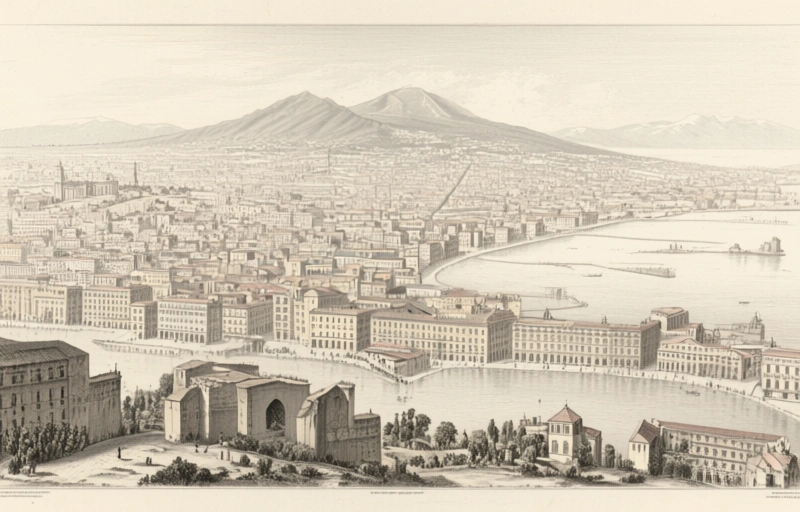
What they discovered completely changes how we see this work. The *Panorama of Naples* is far from a simple, straightforward view. It's a composite. A constructed reality. Stinemolen wasn't just sitting on a hill sketching what he saw. He was making deliberate choices—omitting some things, emphasizing others, possibly even combining multiple perspectives into one seamless image.
This makes the drawing less of a photograph and more of an argument. It tells us what the artist (or his patrons) thought was important about Naples in 1582. Which buildings deserved prominence? What defined the city's identity? The drawing gives us those answers, but we have to know how to look for them.
### The Essential Research Toolkit
To crack this code, the researchers didn't work in isolation. They relied on a crucial body of work, including:
- A core bibliography focused on Stinemolen's panorama itself.
- Additional titles about interpreting Renaissance drawings and city views.
- Digitized, annotated maps from the Bibliotheca Hertziana – Max Planck Institute for Art History.
These digitized resources were game-changers. They allowed for side-by-side comparisons that would have been impossible a generation ago. Researchers could overlay details, trace possible source materials, and follow Stinemolen's thought process across different documents. It was this high-tech approach applied to a centuries-old mystery that really drove the project forward.
### Why This Matters for Professionals
So, you might be wondering, why does a 440-year-old drawing of Naples matter today? Here's the thing—it's a masterclass in critical looking. It teaches us to question our sources, even the visual ones. In an age where we're bombarded with images claiming to show 'the truth,' Stinemolen's work is a powerful reminder: every representation has a perspective. Every creator makes choices.
For professionals working with historical material, this project offers a brilliant methodology. It shows how combining traditional art history with digital tools can lead to breakthrough insights. The team didn't just describe the drawing; they reverse-engineered its creation. That's a powerful approach you can apply to your own work.
In the end, this research reveals the panorama as a sophisticated piece of storytelling. Stinemolen wasn't just documenting Naples; he was interpreting it, shaping it, and presenting a specific version of the city for his audience. And honestly, understanding that makes looking at his work—and any historical document—a much richer experience. It's not just about what you see. It's about why you're seeing it that way.