Unlocking Jan van Stinemolen's 1582 Naples Panorama
Miguel Fernández ·
Listen to this article~4 min
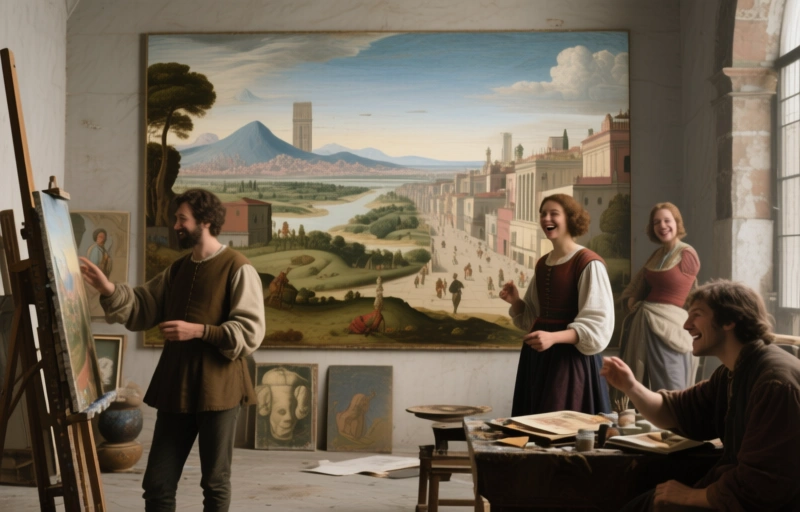
Explore the research behind Jan van Stinemolen's 1582 Panorama of Naples. Discover how scholars moved beyond simple mapping to decode its artistic construction and complex visual narrative.
If you're working with historical cartography or Renaissance art, you've probably come across Jan van Stinemolen's *Panorama of Naples* from 1582. It's one of those pieces that seems straightforward at first glance—a snapshot of a city, right? But dig a little deeper, and you'll find there's so much more going on. That's exactly what a recent collaborative research project set out to explore. They weren't just looking at it; they were trying to see *through* it.
This wasn't a solo effort. It brought together specialists from different fields, all asking the same core questions. What was Stinemolen really showing us? And how did he build this complex visual narrative? The goal was twofold, and both parts were equally ambitious.
### The Quest to Map the Panorama
First, the team wanted to identify as many real-world locations as possible. Think about it. A drawing from 1582 is a historical puzzle. Buildings change, streets get renamed, entire neighborhoods vanish. Pinpointing every church, palace, and street corner in Stinemolen's work is detective work of the highest order. It requires cross-referencing with other sources from the period, which is where the project's foundational resource came in.
They relied heavily on digitized maps from the Bibliotheca Hertziana – Max Planck Institute for Art History. These weren't just scanned images; they were annotated, layered with notes from generations of scholars. This digital archive became the bedrock for their geographical analysis, allowing them to connect Stinemolen's lines and shadows to the actual topography of 16th-century Naples.
### Beyond the Snapshot: Artistic Construction
The second aim was perhaps even more fascinating. The researchers moved beyond the 'what' to investigate the 'how.' They analyzed the drawing's artistic composition and what we call its intermedial construction. In simple terms, they asked: how did Stinemolen use the tools of his trade to create meaning?
This is where the project revealed its biggest insight. The *Panorama of Naples* is far from a simple, objective record. It's a carefully constructed piece of visual rhetoric. Stinemolen made choices—about what to include, what to emphasize, and how to frame the city. His work sits at a crossroads between map-making, landscape painting, and architectural drawing. It's a hybrid, and that's what makes it so powerful.
As one researcher noted, "The panorama is less a mirror of the city and more of a curated portrait, shaped by artistic convention and the creator's intent."
So, what does this mean for professionals like you? It changes how we approach these primary sources. We can't just mine them for data; we have to read them as complex texts. Here are a few key takeaways from the project's methodology:
- **Context is king:** Always situate a visual source within its full artistic and cartographic tradition.
- **Embrace collaboration:** The deepest insights came from merging art historical analysis with historical geography.
- **Question the frame:** Ask why the view is composed this way. What's in the center? What's left at the edges?
- **Leverage digital tools:** Annotated, searchable archives are revolutionizing how we compare and analyze historical images.
This special issue, which the bibliography supports, exemplifies this modern, interdisciplinary approach. It shows that a drawing from 1582 isn't just a static artifact. It's a conversation starter, a portal into how people saw and shaped their world. The essential bibliography that came out of this project isn't just a list of books and articles. It's a roadmap for anyone who wants to continue that conversation, to look at Stinemolen's work—and others like it—with fresh, critical eyes. The next time you're analyzing a historical visualization, remember: you're not just identifying sites. You're decoding a message.