Theo van Doesburg and the Hungarian Avant-Garde
Miguel Fernández ·
Listen to this article~4 min
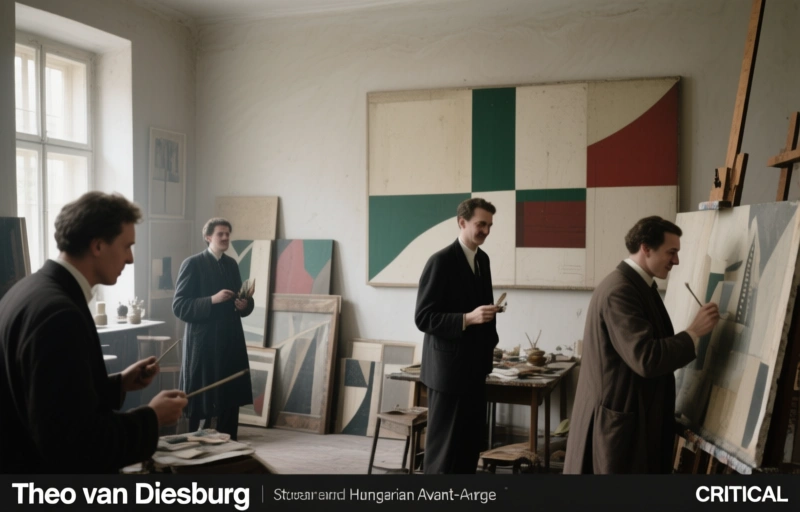
Explore how Theo van Doesburg and Hungarian avant-garde artists like Kassák and Moholy-Nagy traded ideas across Europe in the 1920s, shaping modern art through letters and publications.
Theo van Doesburg was more than just a Dutch artist. He was the driving force behind *De Stijl*, a magazine that reshaped modern art. But his influence didn't stop at the Netherlands' borders. In the early 1920s, he connected with a group of Hungarian avant-garde artists who were pushing boundaries in their own right. This article digs into that cross-cultural exchange, using archival research from Budapest and The Hague to show how these networks worked.
### The Hungarian Connection
Hungary's avant-garde scene was buzzing after World War I. Artists like Lajos Kassák, Sándor Bortnyik, and László Moholy-Nagy were publishing *Ma* (Today), a magazine that championed radical ideas. They weren't just copying Western trends. They were creating their own language—mixing constructivism, expressionism, and political activism. Van Doesburg saw something special in their work. He reached out, and a dialogue began.
What's fascinating is how this wasn't a one-way street. Van Doesburg didn't just teach. He learned. The Hungarians brought a raw energy and a focus on social change that pushed him to think differently. For example, Moholy-Nagy's experiments with light and space later influenced Bauhaus teachings. But back then, it was all about trading ideas through letters, exhibitions, and publications.
### Archival Treasures
The real story lives in the archives. The Kassák Museum in Budapest holds letters, sketches, and drafts that show these artists wrestling with big questions. Over at the RKD in The Hague, Van Doesburg's estate reveals his side of the conversation. Together, these collections paint a picture of a tight-knit network that spanned Europe. You can see how ideas traveled from Amsterdam to Budapest and back again.
One key find: a series of letters from 1922 where Van Doesburg and Kassák debated the role of art in society. Kassák pushed for a more political stance, while Van Doesburg emphasized pure form. They didn't always agree, but that tension fueled some of their best work. It's a reminder that collaboration doesn't mean harmony. Sometimes, it's the friction that sparks creativity.
### What This Means Today
Why should we care about this now? Because the avant-garde wasn't just about art for art's sake. These artists were trying to build a new world. They believed that design, architecture, and painting could reshape how people live. Van Doesburg's connection with the Hungarians shows how international that vision was. It wasn't a Dutch or Hungarian movement. It was a European one.
- It challenges the idea that modernism was a purely Western phenomenon.
- It highlights the role of small magazines like *Ma* and *De Stijl* in spreading ideas.
- It reminds us that creative networks thrive on diversity.
So next time you see a clean geometric design, remember it might have roots in a Budapest café or a Dutch studio. The avant-garde was a conversation, and we're still listening.
### A Micro-Historical Lens
This isn't a sweeping history. It's a micro-history—a close look at specific moments and people. By focusing on van Doesburg and the Hungarians, we see how individual relationships shaped broader trends. It's like zooming in on a single thread in a tapestry. You notice the colors, the knots, the places where it breaks and reconnects. That's where the real story lives.