Naples Through Stinemolen's Eyes: Nature and City in 1582
Miguel Fernández ·
Listen to this article~4 min
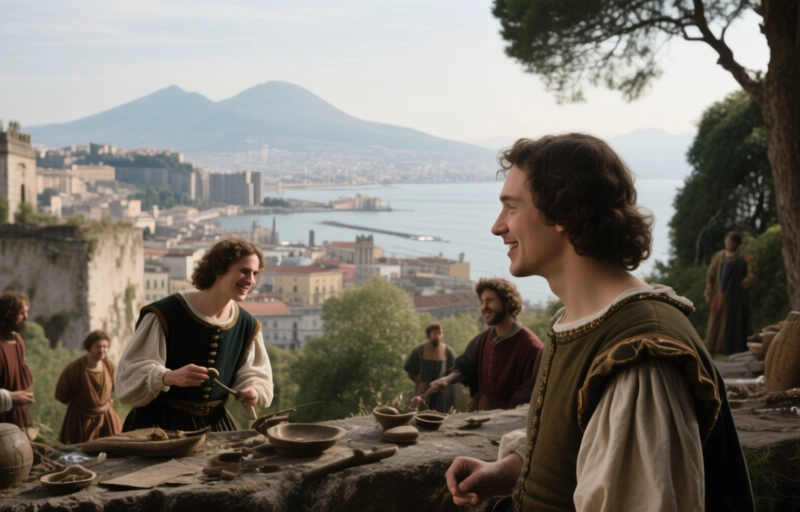
Jan van Stinemolen's 1582 view of Naples offers an unusual environmental perspective, integrating the city with Vesuvius and highlighting natural features. His depiction of gates and walls may be symbolic, reflecting a growing Renaissance interest in geology and ancient ideals.
Let's talk about a map that makes you see a city differently. Jan van Stinemolen's 1582 view of Naples isn't your typical bird's-eye plan. It's something more intimate, more environmental. He didn't just draw buildings and streets. He painted a city living within a dramatic landscape, from the hills right down to the gulf.
You can almost feel the volcanic energy. Vesuvius looms in the distance, and the Phlegraean Fields simmer. Nature isn't just a backdrop here; it's a main character, woven into the city's very fabric. This perspective was pretty unusual for its time. Most maps focused on man-made order. Stinemolen chose to show how Naples was shaped by, and nestled into, its wild surroundings.
### The Curious Case of the City Walls
Now, here's where things get interesting for historians. The fortifications Stinemolen drew don't quite match the official records. We know Viceroy Pedro de Toledo built a specific defensive circuit. But Stinemolen's version shows different forms and connections, especially in the north-western areas.
Scholars have long debated this. Is it an error? A creative liberty? The debate often centers on topographical truth. But maybe we're asking the wrong question. Perhaps Stinemolen wasn't just documenting; he was interpreting.
### A Gate That Shouldn't Be There
Take the monumental gate facing the viewer. It's grand, imposing. The problem? Historical sources say that spot only had a minor opening, a *pertuso*. The actual grand gate, Porta Medina, wasn't built until about sixty years *later*. So why did Stinemolen put it there?
It might seem like a mistake. But what if it was a deliberate choice? This grand gate fits a certain imagery—the idea of an ancient, fortified town. Stinemolen might have been evoking the classical past of Naples, suggesting its timeless, monumental character rather than its exact, contemporary layout.
### Reading the Bedrock: A Naturalist's Eye
Look closer at the drawing. The bedrock isn't just a neutral base. Stinemolen gives it texture, variation, and prominence. He highlights the rocky foundation of the city itself. This focus isn't accidental. Other drawings by him show a similar fascination with geological features.
This aligns perfectly with a growing intellectual movement of the late 16th century: naturalism. Scholars were becoming deeply interested in volcanic phenomena, in how the earth itself shaped human life. Stinemolen's view can be seen as part of this narrative. He wasn't just showing a city; he was showing a city born from fire and stone.
- **Unusual Perspective:** Surveying from hillside to gulf, not from above.
- **Nature Integrated:** Vesuvius and fields are central, not peripheral.
- **Architectural Liberties:** Gates and walls may represent ideals, not strict reality.
- **Geological Focus:** The bedrock is detailed, reflecting contemporary scientific interest.
As one analysis puts it, "The drawing becomes less a strict document and more a layered representation—part topography, part symbolism, part natural philosophy."
So, what are we left with? We have a view that challenges us to think beyond simple accuracy. Stinemolen gives us a Naples that is both a real place and an idea—a city inseparable from its volatile, beautiful environment. For professionals studying urban depiction, it's a masterclass in how perspective shapes meaning. The map tells us as much about the 16th-century mind looking at nature as it does about 16th-century Naples itself.