Naples' Rocky Foundation: Jan van Stinemolen's 1582 View
Miguel Fernández ·
Listen to this article~3 min
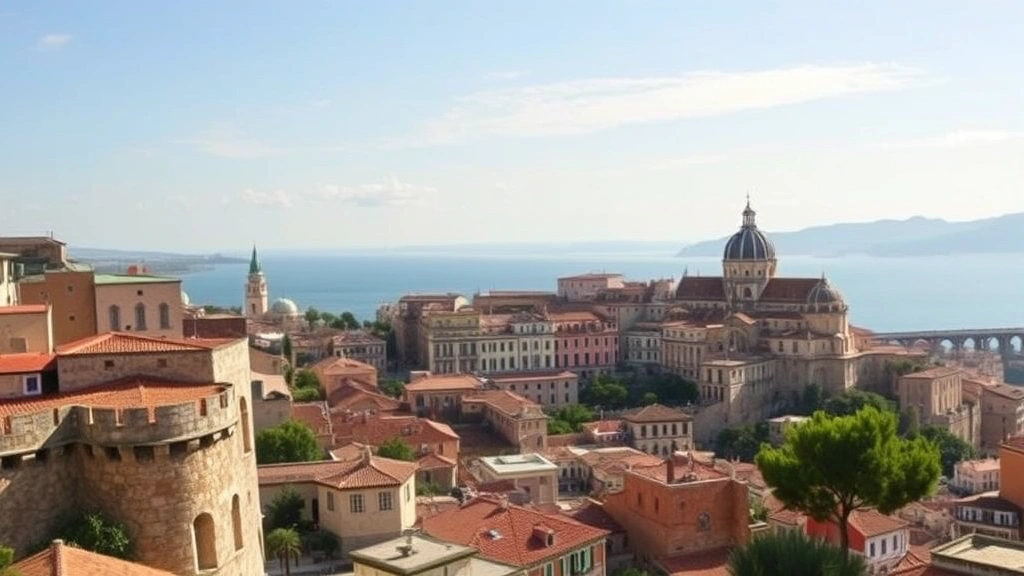
Jan van Stinemolen's 1582 view of Naples broke conventions by surveying the city from the hillside, embedding it within its volcanic landscape and raising intriguing questions about its depicted fortifications and gates.
Let's talk about a map that changed the perspective on an entire city. Back in 1582, an artist named Jan van Stinemolen did something different with Naples. While everyone else was drawing the city from the usual angles, he took a step back—way back, up onto the hillside. This wasn't just a new vantage point; it was a whole new way of seeing.
His view stretches from the Gulf of Naples all the way to Vesuvius and the Phlegraean Fields. Suddenly, you don't just see a city. You see a city *in* its environment, nestled within this dramatic, volcanic landscape. Nature isn't just the backdrop here; it's a central character, both outside and inside the city walls.
### The Mystery of the Walls and Gates
Now, here's where it gets really interesting for anyone studying urban history. Stinemolen's drawing shows fortifications that don't quite match the official records. We know Viceroy Pedro de Toledo built a specific defensive circuit, but Stinemolen's version looks different in both form and how it connects to the northwestern neighborhoods.
Scholars have debated this for ages. Is it a mistake? A creative liberty? The biggest clue might be a gate. Stinemolen draws a grand, monumental gate facing the viewer. But historical sources say that spot only had a small opening back then, a *pertuso*. The actual grand gate for that area, the Porta Medina, wasn't built until about sixty years later!
So why draw a gate that wasn't there? It might not be an error at all. This kind of feature—a grand, ancient-looking gate—was a common visual shorthand in art for depicting old, venerable towns. Stinemolen might have been intentionally evoking the idea of Naples as an ancient city, layering its long history into a single image.
### Reading the Bedrock: A Naturalist's Eye
Beyond the architecture, Stinemolen pays incredible attention to the land itself. The bedrock isn't just a brown smudge under the buildings. He shows its t
exture, its variation, how it rises and falls. This detail is a big deal.
- It highlights the unique, unstable volcanic geology Naples is built upon.
- It shows an artist deeply interested in natural phenomena.
- It parallels a growing scientific curiosity about volcanoes in the late 16th century.
In other words, Stinemolen wasn't just mapping streets; he was documenting the very ground the city stood on. His work connects to a broader narrative of early natural science, where artists and scholars began observing the physical world with fresh, detailed eyes.
Think of it like this: before satellite imagery, an artist's view was the closest thing to a geographical survey. Stinemolen's 1582 drawing is more than a pretty picture. It's a historical document, a piece of scientific observation, and a statement about how a city relates to its natural world. It reminds us that to understand a place, you sometimes have to climb the hill and look at the whole story, from the bedrock up.