Naples' Rocky Foundation: Jan van Stinemolen's 1582 View
Miguel Fernández ·
Listen to this article~4 min
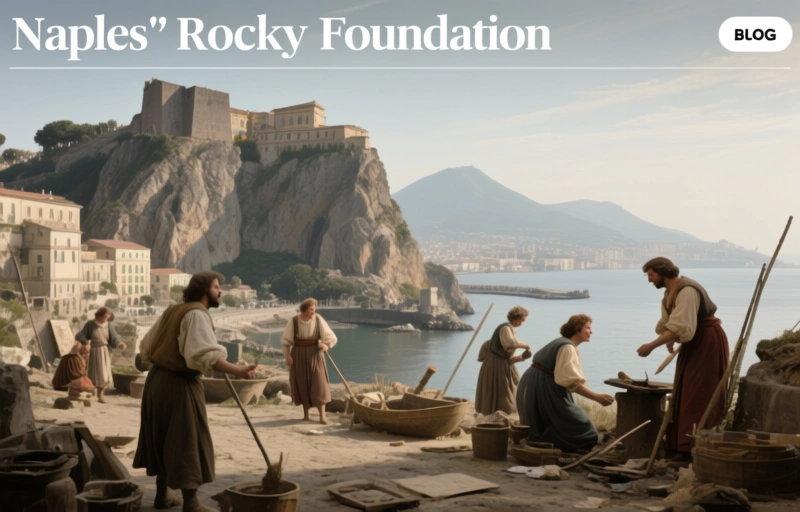
Jan van Stinemolen's 1582 view of Naples reveals the city embedded in its volcanic landscape. His unusual hillside perspective and puzzling architectural details offer a unique narrative about nature, history, and artistic intention.
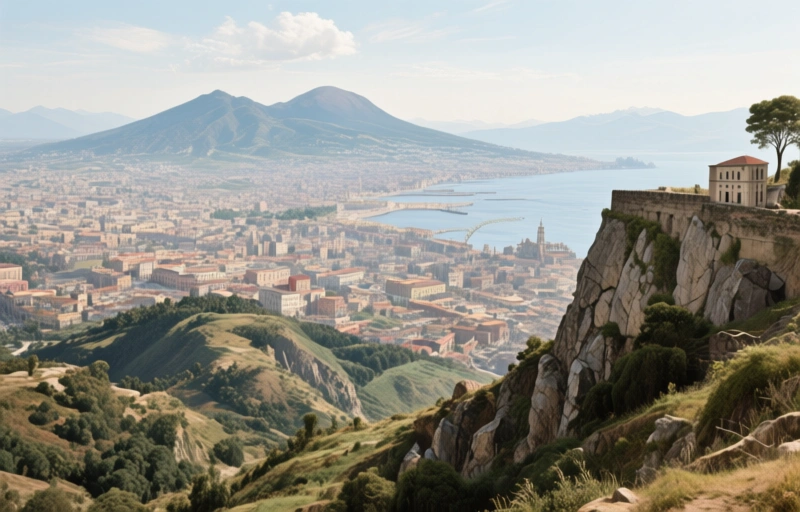
Let's talk about a map that changed the perspective on an entire city. Back in 1582, artist Jan van Stinemolen didn't just draw Naples. He captured its soul, embedded in the dramatic landscape between Vesuvius and the Phlegraean Fields. While other maps of the time focused on streets and buildings, Stinemolen took a step back—way back, up on the hillside. His view sweeps from the high ground down to the gulf, making you feel the city's connection to the powerful natural world around it. It's a perspective that makes you see Naples not just as a collection of structures, but as an organism growing from the rock itself.
### A View From the Hills
This unusual vantage point wasn't common for the era. Most city views were flat, like blueprints from above. Stinemolen's choice to survey from the hillside was revolutionary. It allowed viewers to perceive the city's relationship with its wider environment in a single, breathtaking glance. You can almost feel the volcanic energy of the region. This wasn't just topography; it was an early form of environmental storytelling. The drawing emphasizes how nature wasn't just outside the walls—it was a fundamental character inside them, shaping where and how people lived.
### The Mystery of the Walls and Gates
Now, here's where it gets really interesting for historians. The fortifications Stinemolen drew don't quite match the official records. We know Viceroy Pedro de Toledo built a specific defensive circuit. But Stinemolen's version shows different forms and connections, especially in the north-western urban areas. Scholars have debated this for years. Is it an error, or something more intentional?
The biggest clue might be the gate. Stinemolen depicts a monumental, imposing gate facing the viewer. Yet, historical sources from that exact time mention only a minor opening there, a simple passage locals called a *pertuso*. The actual grand gate for that area, the Porta Medina, wasn't built until about sixty years later. So why did he draw it?
One compelling theory is that Stinemolen wasn't just recording what he saw. He was evoking an *idea* of Naples. The grand, ancient-looking gate fits the imagery of classical, timeless towns. It might have been an artistic choice to emphasize the city's perceived antiquity and grandeur, blending observed reality with cultural narrative.
### Reading the Bedrock: Nature as Narrative
Perhaps the most striking feature is the attention to the bedrock. The drawing meticulously shows the rocky foundation of the city, its variations and textures. This wasn't a one-off for Stinemolen. His other works show a similar fascination with geological forms. This focus provides a key to understanding his intent. He was highlighting the natural phenomena unique to the Neapolitan region—the volcanic bedrock, the looming presence of Vesuvius.
This paralleled a growing intellectual movement of the time: a naturalist interest in volcanic activity and earth sciences. Stinemolen's view can be seen as part of that conversation, using art to document and ponder the powerful forces that literally shaped the city. His work asks us to consider:
- How does the land beneath a city define its character?
- Can a map tell a story about natural history, not just human history?
- When is an artistic "inaccuracy" actually a deeper truth?
In the end, Jan van Stinemolen's 1582 view of Naples is more than a map. It's a philosophical statement on canvas. It reminds us that cities are not separate from nature. They are expressions of it, built upon and shaped by the ancient, rocky foundations we often forget to see. His unusual perspective challenges us to look at our own urban environments with the same holistic wonder, to see the bedrock beneath the pavement.