Naples' Rocky Foundation: Jan van Stinemolen's 1582 View
Miguel Fernández ·
Listen to this article~4 min
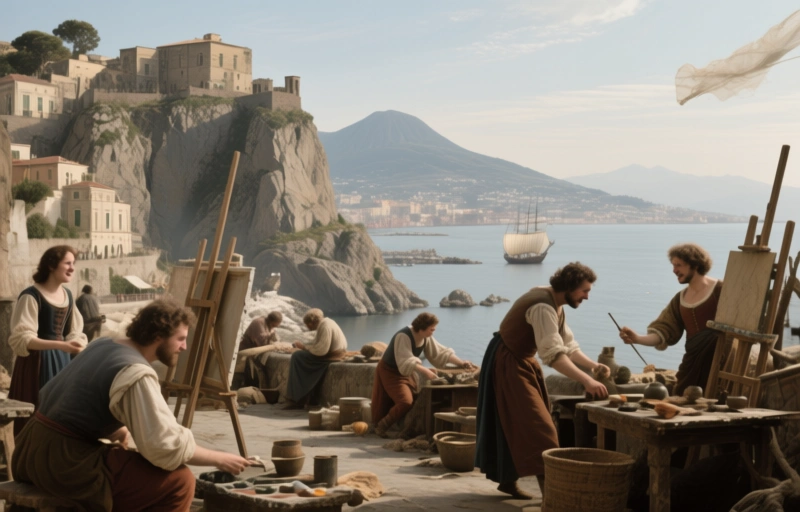
Jan van Stinemolen's 1582 view of Naples offers a unique perspective, embedding the city within its volcanic landscape. This analysis explores its puzzling inaccuracies and suggests they were intentional, reflecting a growing Renaissance interest in natural phenomena.
Let's talk about a map that changed how we see Naples. Back in 1582, artist Jan van Stinemolen didn't just draw another city plan. He did something different. He climbed up the hillside and looked down toward the gulf. That simple shift in perspective changed everything.
You see, most maps before this focused on streets and buildings. Stinemolen's view makes you feel the landscape. You see Naples not as an isolated city, but as a place nestled within a dramatic natural theater. From the looming presence of Vesuvius to the sprawling Phlegraean Fields, nature isn't just the backdrop here. It's a main character.
### The Puzzle of the City Walls
Now, here's where things get interesting for historians. When you look at the fortifications Stinemolen drew, they don't quite match the official records. We know Viceroy Pedro de Toledo built a specific defensive circuit. But Stinemolen's walls look different in form and how they connect to the northwestern parts of the city.
This has sparked a lot of debate. Is the drawing topographically inaccurate? Or is the artist telling us a different story? Scholars have long wrestled with this question of "truth" in the depiction.
### The Mystery of the Monumental Gate
My starting point is a fascinating detail. Right there, facing the viewer, Stinemolen drew a grand, monumental gate. It looks important and ancient. But here's the catch: historical sources say that spot only had a minor opening back then, a simple passage called a *pertuso*. The actual grand gate for that area, the Porta Medina, wasn't built until about sixty years *later*.
So why draw a gate that didn't exist? It seems like a glaring inconsistency. But what if it wasn't a mistake? What if it was intentional? This grand gate fits a specific visual language—the imagery of ancient, classical towns. Stinemolen might have been evoking Naples' deep historical roots, painting it as a successor to classical antiquity, rather than documenting its exact 16th-century state.
### Reading the Bedrock: A Naturalist's Eye
Perhaps the most compelling clue is how Stinemolen treats the land itself. He pays extraordinary attention to the bedrock. You can see its relevance and visual variation across the drawing. This wasn't a one-off. His other works show the same careful observation of rock formations and terrain.
This emphasis is a big deal. It parallels a growing intellectual movement of the time: a rising naturalist interest in volcanic phenomena. Scholars were starting to study volcanoes like Vesuvius not just as fearsome forces, but as natural wonders to be understood.
- Stinemolen's view embeds the city within its volcanic landscape.
- His detailed bedrock suggests a study of geology.
- The drawing acts as a visual companion to new scientific narratives.
In a way, he wasn't just mapping a city. He was mapping a relationship—between human settlement and the powerful, rocky foundation it was built upon. The drawing becomes a document of place, where culture and nature collide. It asks us to consider whether a city's true character comes from its buildings or from the land that holds them up.
That's the real value of looking at this old view. It gives us a lens into a moment when how people saw the world—both the built and the natural—was fundamentally shifting.