Naples' Rocky Foundation: Jan van Stinemolen's 1582 View
Miguel Fernández ·
Listen to this article~4 min
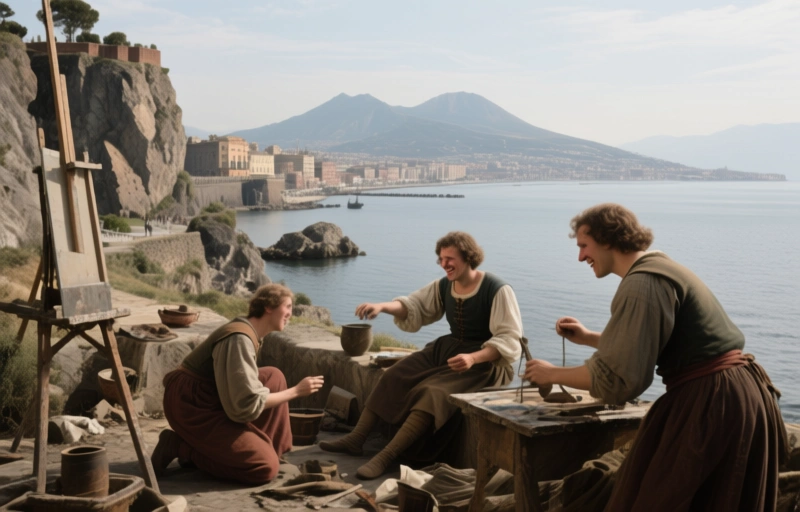
Jan van Stinemolen's 1582 view of Naples reveals the city embedded in its volcanic landscape. His unusual perspective highlights nature's role and raises questions about historical accuracy in Renaissance cartography.
Let's talk about a map that changed the perspective on an entire city. Back in 1582, Jan van Stinemolen didn't just draw Naples—he framed it within its dramatic natural theater. While other cartographers focused on streets and buildings, Stinemolen stepped back. Way back.
He surveyed the city from the hillside looking down toward the gulf. This wasn't the usual bird's-eye view. It was more like standing beside him on that slope, seeing what he saw: Naples not as an isolated urban center, but as a city embedded in something much larger.
### The Unusual Perspective
What makes this view so special? It captures the entire environmental context. From the looming presence of Vesuvius to the sprawling Phlegraean Fields, nature isn't just background scenery here. It's a fundamental character in the story of Naples. Stinemolen shows us how the city exists within this volcanic landscape, something previous maps barely hinted at.
Inside the city walls, nature continues to play a role. But there's something else going on with those fortifications too. They don't match what historical records tell us about Viceroy Pedro de Toledo's defensive circuit. The form is different. The connection to northwestern urban areas doesn't align with known layouts.
This discrepancy has fueled scholarly debate for years. Is Stinemolen taking artistic license? Or is he documenting something we've missed?
### The Mysterious Gate
Here's where it gets really interesting. Stinemolen depicts a monumental gate facing the viewer. It's an impressive structure with an oddly fashioned design. The problem? Other historical sources from that time mention only a minor opening at that location—a simple passage called a *pertuso*.
The actual gate, Porta Medina, wouldn't be built for another sixty years. So what's Stinemolen showing us?
- He might be incorporating elements of ancient towns into his depiction
- The gate could represent an idealized version of city entrances
- Perhaps he's blending different time periods into a single vision
These seemingly inconsistent features actually match imagery associated with ancient towns. They might be intentional, suggesting Stinemolen wanted to emphasize Naples' classical heritage alongside its natural setting.
### Reading the Bedrock
Now let's talk about the ground beneath the city. Stinemolen pays remarkable attention to the bedrock. Its relevance and visual variation across the drawing provide crucial clues. He's not just showing rocks—he's highlighting the natural phenomena peculiar to the Neapolitan region.
This emphasis parallels scholarly narratives emerging at the time. There was growing naturalist interest in volcanic phenomena during the late Renaissance. Scientists and artists alike were beginning to study these forces systematically.
Stinemolen's work sits at this intersection. His view of Naples does more than document topography. It reflects a changing understanding of how human settlements interact with volatile landscapes. The bedrock isn't just foundation—it's character, history, and potential threat all rolled into one.
As one contemporary observer noted about such works: "They teach us to see cities as living entities shaped by the land that holds them."
### Why This Matters Today
Looking at Stinemolen's view now, we're reminded that cities are never separate from their environments. His unusual perspective forces us to consider Naples as part of a larger system. The volcanic forces that shaped the land continue to influence the city's development, architecture, and very identity.
This 1582 drawing offers more than historical documentation. It provides a framework for understanding how artists and mapmakers interpret the relationship between built environments and natural landscapes. In an age of climate awareness, that perspective feels remarkably current.
Stinemolen didn't just capture what Naples looked like in 1582. He captured how it felt to be a city living on volcanic ground, surrounded by natural forces both beautiful and dangerous. That's the real genius of his work—showing us the rocky foundation, both literal and metaphorical, upon which Naples was built.