Naples' Rocky Foundation: Jan van Stinemolen's 1582 View
Miguel Fernández ·
Listen to this article~4 min
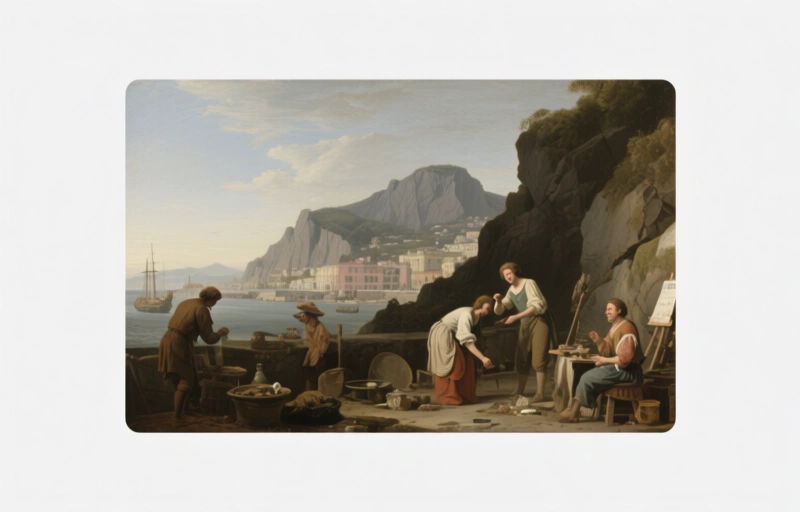
Jan van Stinemolen's 1582 view of Naples offers a revolutionary perspective, embedding the city within its volcanic landscape and raising fascinating questions about historical accuracy versus artistic storytelling.
Let's talk about a map that changed how we see Naples. In 1582, Jan van Stinemolen didn't just draw another city plan. He gave us a perspective that feels almost cinematic for its time. Instead of looking straight down or from sea level, he positioned his view from the hillside looking toward the gulf. That simple shift changes everything.
You suddenly see Naples not as an isolated fortress, but as a city woven into a dramatic landscape. Vesuvius looms in the distance, the Phlegraean Fields stretch out. The natural world isn't just a backdrop here—it feels like a main character. The city walls and streets seem to grow right out of the bedrock.
### The Puzzle of the City Walls
Now, here's where things get interesting for anyone studying urban history. Stinemolen's depiction of the fortifications doesn't quite match the official records. We know Viceroy Pedro de Toledo built a specific defensive circuit. But in this drawing, the walls look different, especially where they connect to the northwestern neighborhoods.
Scholars have debated this for years. Is it an error? A creative liberty? The question of topographical truth has been a major focus. But maybe we're asking the wrong question. Perhaps accuracy wasn't his only goal.
### The Mysterious Gate That Shouldn't Exist
Take the monumental gate facing the viewer. It's rendered with impressive, almost archaic detail. The odd thing? Historical sources say that spot only had a minor opening called a *pertuso* at that time. The actual grand gate, Porta Medina, wasn't built until about sixty years later.
So why include it? This seemingly inconsistent feature might be the key. It matches the visual language used for ancient, classical towns. Stinemolen might have been intentionally evoking Naples' deep history, painting it not just as a 16th-century city, but as an heir to antiquity. He wasn't just documenting; he was storytelling.
### Reading the Land Itself
What truly stands out is how Stinemolen treats the bedrock. He doesn't smooth it over or treat it as mere ground. He shows its texture, its variation, its relevance. Look at his other drawings of the region—he consistently emphasizes these natural formations.
This wasn't random artistic flair. It aligned perfectly with a growing intellectual movement of the time. Naturalist interest in volcanic phenomena was surging. Scholars were beginning to study the land itself as a historical record.
- Stinemolen's view connects urban form to geological reality
- It presents nature as integral, not incidental, to the city's identity
- The drawing parallels emerging scientific narratives about the Neapolitan region
In essence, he was doing something radical for a city view. He was showing how the land shaped the city, and how the city responded to the land. The rocky foundation wasn't just something to build on—it was part of Naples' soul.
As one scholar noted, "The most truthful maps sometimes show us not just where things are, but what they mean." Stinemolen's 1582 view gives us both. It's a technical document and a philosophical statement. It asks us to see Naples not as a collection of buildings, but as a dialogue between human settlement and an ancient, volatile, beautiful landscape. That's a perspective that feels remarkably modern, even today.