Naples' Rocky Foundation: Jan van Stinemolen's 1582 View
Miguel Fernández ·
Listen to this article~4 min
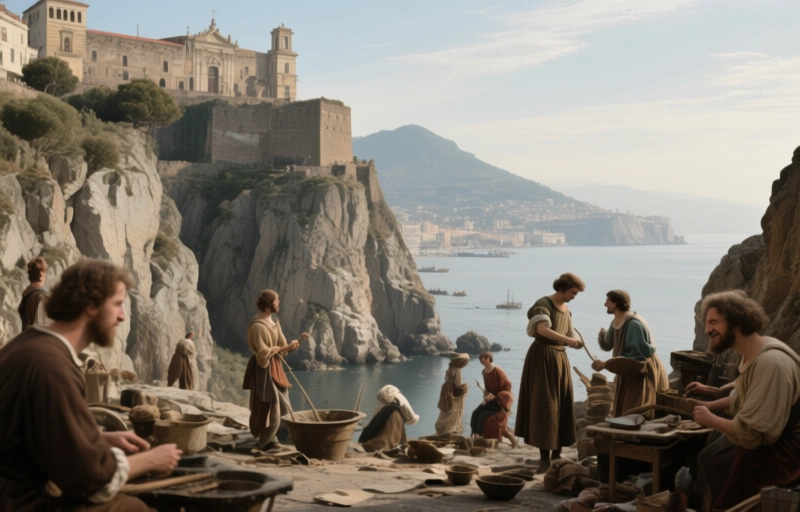
Explore Jan van Stinemolen's unique 1582 view of Naples, which reveals the city's deep connection to its volcanic landscape and challenges historical records with intentional artistic choices.
Let's talk about a map that changed how we see Naples. In 1582, artist Jan van Stinemolen didn't just draw another city plan. He gave us a perspective no one else had tried. Instead of looking straight down or from sea level, he perched up on the hillside. This simple shift in viewpoint changed everything.
You suddenly see Naples not as an isolated fortress, but as a city woven into an epic landscape. Vesuvius looms in the distance. The Phlegraean Fields stretch out. The gulf cradles the coastline. Nature isn't just a backdrop here—it's the main character, both outside and within the city walls themselves.
### The Puzzle of the City Walls
Now, here's where things get interesting for any historian or cartography enthusiast. Stinemolen's depiction of Naples's fortifications doesn't match the official records. We know Viceroy Pedro de Toledo built a specific defensive circuit. But Stinemolen's drawing shows something different in form and how it connects to the northwestern neighborhoods.
Scholars have debated this for ages. Is it an error? A creative liberty? The debate often centers on 'topographical truth.' But maybe we're asking the wrong question.
### The Mystery of the Monumental Gate
My starting point is a fascinating detail. Front and center in the view is a huge, imposing gate. It faces the viewer with an oddly grand design. The catch? Historical sources say that spot only had a small opening back then, a *pertuso* (basically a hole in the wall). The real grand gate for that area, the Porta Medina, wasn't built until about sixty years *later*.
So why did he draw it? It seems like a glaring inconsistency. But what if it wasn't a mistake? What if it was intentional?
- **Ancient Imagery:** The grand gate might be a visual cue. It matches the common imagery of ancient, classical towns that people in the Renaissance admired. Stinemolen could have been evoking Naples's deep Roman history.
- **Artistic Statement:** Perhaps he wasn't documenting the city as it was, but as it *felt*—a monumental, historic place emerging from the rock.
### Reading the Bedrock
This leads to the most compelling part, the 'rocky foundation' of the title. Stinemolen didn't just draw buildings. He meticulously rendered the bedrock. You can see its relevance and visual variation throughout the drawing. Look at his other works, and you'll see this wasn't a one-off. He was obsessed with depicting the raw, natural foundation of the Neapolitan region.
This wasn't just pretty scenery. It was a scholarly statement. At the time, there was a growing naturalist fascination with volcanic phenomena. Think about it—Naples sits between Vesuvius and the Phlegraean Fields, a geological hotspot.
By emphasizing the bedrock and the volcanic landscape, Stinemolen was participating in that very conversation. His view is less a strict map and more a naturalist's portrait of a city defined by its powerful, unstable earth.
As one scholar might muse, "Sometimes a map tells us more about what people were thinking about than about the streets they walked on."
So, next time you look at an old city view, don't just look for accuracy. Look for the story the artist wanted to tell. Stinemolen wasn't just showing us Naples. He was showing us a city born from fire and stone, forever connected to the dramatic forces that shaped it. That's a perspective worth remembering.