Jan van Stinemolen and His Panoramic View of Naples
Miguel Fernández ·
Listen to this article~3 min
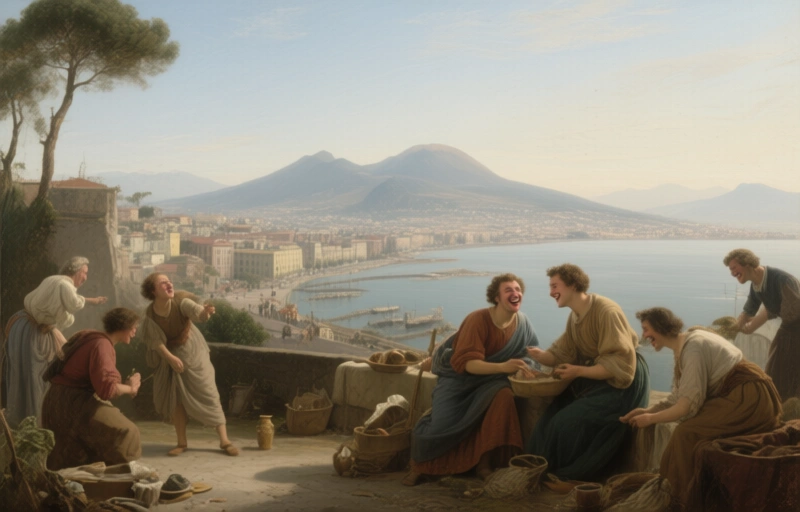
Jan van Stinemolen created a stunning panoramic view of Naples that blends mapmaking with art. Learn about this forgotten 16th-century artist and his unique vision.
Jan van Stinemolen (1518–1582) is one of those artists who should be a household name, but isn't. You've probably never heard of him, and that's a shame. He created a stunning panoramic view of Naples that blends mapmaking with art in a way that feels almost modern. But his story is a puzzle, and we only have a few pieces.
### Who Was Jan van Stinemolen?
We don't have a biography from his time. He's not even mentioned in Karel van Mander's *Schilder-Boeck*, the go-to book on Dutch and Flemish painters. So what do we know? Archival records show he lived in the Spanish Netherlands, first in Mechelen and later in Antwerp. He was likely a silversmith and jeweler, just like other members of his family. That was a good gig back then, but it probably got complicated when religious wars broke out in his homeland.
His travels are a mystery. We know he made it to Naples and southern Italy. A drawing suggests he even visited Sicily. But the exact dates? Nobody knows. And here's the kicker: none of his silverwork has survived. Zip. Nada. All we have left are a few drawings and one spectacular painting: the *View of Naples*.
### The Art of Blending Maps and Views
Stinemolen's panorama is special because it mixes two things: a topographical map and a perspective view. Think of it like Google Maps satellite view combined with street view, but painted in the 16th century. That mix might have roots in Mechelen, where urban cartography was booming at the time. Artists there were obsessed with capturing cities from above and from the ground.
What's even cooler is his fascination with volcanic landscapes. You can see it in his drawings. He was clearly drawn to the raw power of nature, especially in a place like Naples, which sits near Mount Vesuvius. That volcano shaped everything about the region, and Stinemolen captured it.
### What We Can Learn from His Work
The *View of Naples* isn't just a pretty picture. It tells us a lot about Stinemolen's motivations and interests. Here are a few things we can guess:
- He was deeply curious about natural history. The volcanic formations aren't just background; they're a focus.
- He understood the power of perspective. The way he combines map and view shows he was thinking like both an artist and a scientist.
- He might have been trying to show off his skills as a cartographer. In Mechelen, mapmaking was a big deal, and he wanted to prove he could do it.
### The Bigger Picture
Stinemolen's story reminds us that history is full of forgotten geniuses. We don't have his silverwork, and we don't have a clear timeline of his life. But we have his art. And that art speaks volumes. It's a window into a world where art, science, and exploration were all tangled together.
So next time you see a panoramic view of a city, think of Jan van Stinemolen. He was doing it 500 years ago, and he did it without Google Maps.