Unlocking Jan van Stinemolen's 1582 Panorama of Naples
Miguel Fernández ·
Listen to this article~4 min
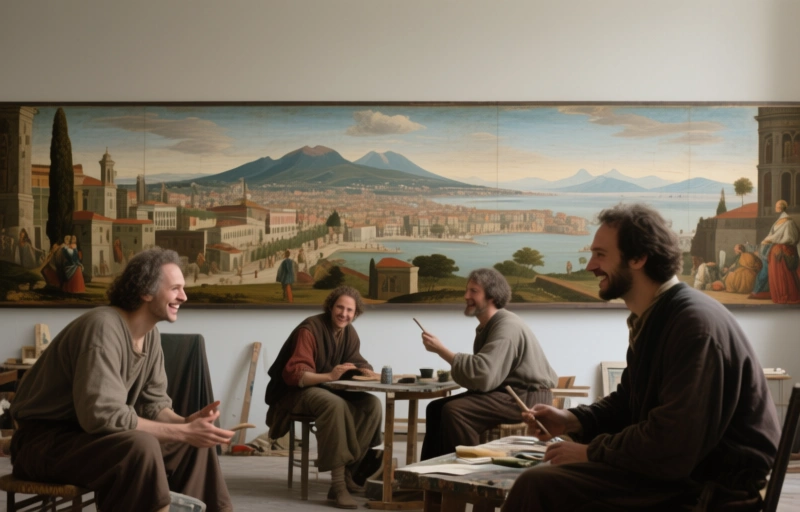
New research reveals Jan van Stinemolen's 1582 Panorama of Naples is not a simple snapshot but a complex, intermedial construction. Discover how digitized maps and collaborative analysis unlocked its true meaning.
If you're working with historical art or cartography, you've probably come across Jan van Stinemolen's *Panorama of Naples* from 1582. It's a stunning piece, but let's be honest—it's also a bit of a mystery. For years, folks treated it like a simple snapshot, a straightforward view of the city. But a recent collaborative research project dug deeper, and what they found changes everything.
This wasn't just an artist setting up an easel. Stinemolen's work is a complex, intermedial construction. It blends art, map-making, and a specific point of view into something far more intentional. The project had two main goals, and they're both crucial for understanding the piece's real value.
### The Hunt for Lost Landmarks
The first goal was straightforward, though not simple: identify as many sites in the drawing as possible. Think of it like a historical scavenger hunt. The team didn't just rely on the drawing itself. They turned to a treasure trove of digitized maps from the Bibliotheca Hertziana – Max Planck Institute for Art History.
These annotated maps were fundamental. They provided the context needed to match Stinemolen's artistic rendering with the actual geography of 16th-century Naples. It was about piecing together a puzzle that's over 440 years old.
- **Comparing perspectives:** Where did Stinemolen stand? How did his vantage point distort or emphasize certain buildings?
- **Verifying architecture:** Does that tower match the known records? Is that plaza in the right location?
- **Understanding urban layout:** The drawing reveals how the city was organized, which streets were prominent, and how space was used.
This meticulous work revealed the panorama as a deliberate document, not a casual sketch. Every building, every street corner was placed with purpose.
### Decoding the Artistic Blueprint
The second goal was where things got really interesting. The team investigated the artistic composition and "intermedial construction." That's a fancy term for asking: how did he *build* this image using different media and techniques?
This is where we move past "what" we see to "how" and "why" we see it. The research showed Stinemolen made conscious choices about:
- **Framing and focus:** What's in the center? What's faded into the background? This tells us what he, or his patrons, considered important.
- **Blending of genres:** It's part landscape painting, part topographic map. This hybrid approach was innovative for its time.
- **Narrative intent:** The panorama tells a story of Naples as a powerful, thriving city. It's a piece of propaganda as much as it is a record.
As one researcher involved noted, "The revelation was that this work is far from a simple snapshot. It's a calculated representation, a statement. It makes you question everything you thought you knew about how cities were portrayed in that era."
### Why This Research Matters for Professionals
So, why should you care if you're in the abbevillemusique field or any related historical arts profession? This case study is a masterclass in methodology. It shows the power of interdisciplinary collaboration—bringing together art historians, cartographers, and digital archivists.
The approach taken here, using digitized primary sources to interrogate an artistic work, sets a precedent. It proves that even the most studied pieces can yield new secrets when we ask new questions and use new tools. The essential bibliography that came from this project isn't just a reading list; it's a roadmap for future research, showing how to bridge the gap between art object and historical document. It reminds us that our job is often to look past the surface and uncover the layers of meaning that have been hiding in plain sight for centuries.