Unlocking Jan van Stinemolen's 1582 Panorama of Naples
Miguel Fernández ·
Listen to this article~3 min
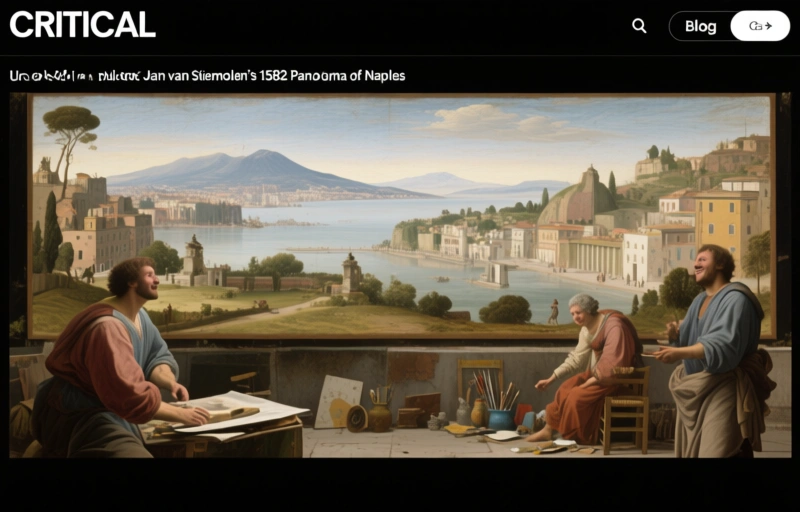
New research reveals Jan van Stinemolen's 1582 Panorama of Naples is a complex artistic composition, not a simple snapshot. Discover how scholars decoded its sites and intermedial construction.
If you're working with historical cartography or Renaissance art, you've probably heard whispers about Jan van Stinemolen's *Panorama of Naples* from 1582. It's one of those pieces that seems straightforward at first glance—a snapshot of a city, frozen in time. But let me tell you, it's so much more than that. A recent collaborative research project dug deep, and what they found completely redefines how we see this work. It's not just a map or a drawing; it's a carefully constructed artistic statement.
This wasn't a solo mission. Scholars teamed up with a clear, two-part goal. First, they wanted to identify as many real-world locations in the panorama as possible. Think of it like a historical treasure hunt, matching Stinemolen's lines and shapes to the actual streets, buildings, and landmarks of 16th-century Naples. The second goal was even more intriguing: to crack the code of its artistic composition. How did Stinemolen build this view? What techniques and media did he blend together? The answers show this is far from a simple sketch.
### The Research Behind the Drawing
So, how do you even start a project like this? The team didn't work from photocopies. They relied on a crucial resource: digitized maps from the Bibliotheca Hertziana – Max Planck Institute for Art History. These weren't just any maps; they were annotated, marked up by experts, and became the essential roadmap for the entire investigation. This foundation allowed the researchers to follow a precise methodology, comparing the artistic rendering with the cartographic reality.
The process revealed Stinemolen's genius. He wasn't just documenting; he was composing. The panorama uses what we now call *intermedial construction*. That's a fancy term for blending different artistic mediums and techniques to create something new. He combined the precision of a surveyor with the eye of a painter, resulting in a work that is both geographically informative and profoundly artistic.
### Why This Changes Everything
Here's the kicker: this research moves the *Panorama of Naples* out of the archive and into the conversation about Renaissance artistry. It's a reminder that historical documents are often layered creations. They have agendas, styles, and hidden complexities. For professionals, this means we have to look at similar works with fresh eyes. Ask new questions:
- What is the artist *choosing* to show or emphasize?
- What techniques are being used to create a specific impression?
- How does the medium shape the message?
This project's essential bibliography, which includes titles on interpreting the drawing, is a toolkit for anyone wanting to dive deeper. It points you toward the critical analyses that unpack these very questions.
To put it simply, Stinemolen gave us a portrait, not a photograph. And understanding the difference is everything. This collaborative work shows that even a 440-year-old drawing can still surprise us, challenge our assumptions, and teach us new ways to see the past. It's a fascinating case study in looking beyond the surface.