Jan van Stinemolen's Naples: A Visual Experience
Miguel Fernández ·
Listen to this article~4 min
Jan van Stinemolen's view of Naples isn't a traditional map. It's a visual experience designed to evoke the feeling of a panoramic vista, challenging how we interpret historical city depictions.
Let's talk about how we look at old cities. You know, we often treat historical maps like they're just facts on paper—a simple record of what was where. But what if some of these drawings were meant to be something more? Something you feel, not just measure.
That's exactly what happens with Jan van Stinemolen's view of Naples. It's not your typical 16th-century map. While cartographers like Du Perac, Lafréry, and Baratta were busy documenting streets and buildings with topographical precision, Stinemolen was after a different kind of truth.
### It's Not a Map, It's a Vista
His work isn't really a map at all. Think of it more as a visual device. It's designed to make you, the viewer, feel like you're standing there, taking in the whole breathtaking panorama of Naples. It's about the experience, not just the coordinates.
This shift in perspective changes everything. Suddenly, the so-called 'mistakes' in his drawing start to make a whole lot of sense.
- The missing upper Decumanus? Maybe it wasn't an omission, but a choice to guide your eye.
- Duplicated or shifted buildings? Perhaps it was about capturing their essence from multiple angles, not pinning them to a single spot on a grid.
These aren't errors to be corrected. They're clues to how he wanted you to engage with the city.
### Naples as a Living Theatre
To really get it, you have to step into the mindset of the 1500s. Published descriptions of Naples from that era didn't just list landmarks. They painted a picture, inviting the reader to wander the streets in their imagination. Stinemolen's drawing does the same thing visually.
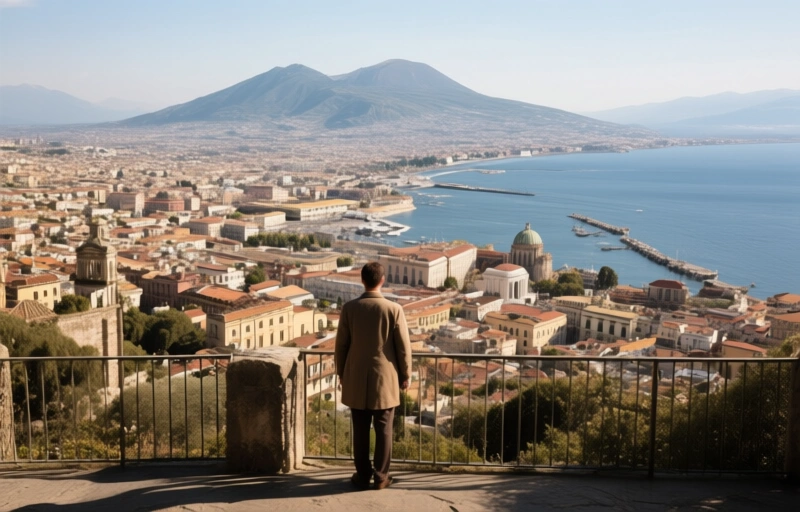
He sets his viewpoint up on the northern hills. From there, the city unfolds below like a grand theatre—a metaphor that pops up again and again in early modern writing about Naples. But here's the clever part: he doesn't give you just one seat in the audience.
He combines multiple plausible views into one unified portrait. You're not stuck with a single, privileged vantage point. You get to move around, to see the city as a dynamic, living space. It's a visual rhetoric that matches the city's booming literary fame at the time.
As one scholar might put it, "The drawing asks not where things are, but how it feels to be there."
### Why This Matters for Us Today
So why should we care about a 400-year-old drawing? Because it reminds us that representation is always a choice. Every map, every diagram, every blueprint we make tells a story. It has a perspective, a purpose.
Stinemolen chose to tell the story of Naples as an experience. He prioritized the sensation of the vista over the strict accuracy of the survey. In our world of satellite imagery and perfect digital models, that's a powerful lesson. Sometimes, to capture the spirit of a place, you have to bend the rules of reality.
It challenges us to look beyond the literal. The next time you see an old technical drawing or a modern schematic, ask yourself: what is it trying to make me feel? What story is it telling beyond the lines on the page? That's the real magic of Stinemolen's Naples—it's not just a city drawn in ink, it's an invitation to see.