Jan van Stinemolen's Naples: A Visual Experience
Miguel Fernández ·
Listen to this article~4 min
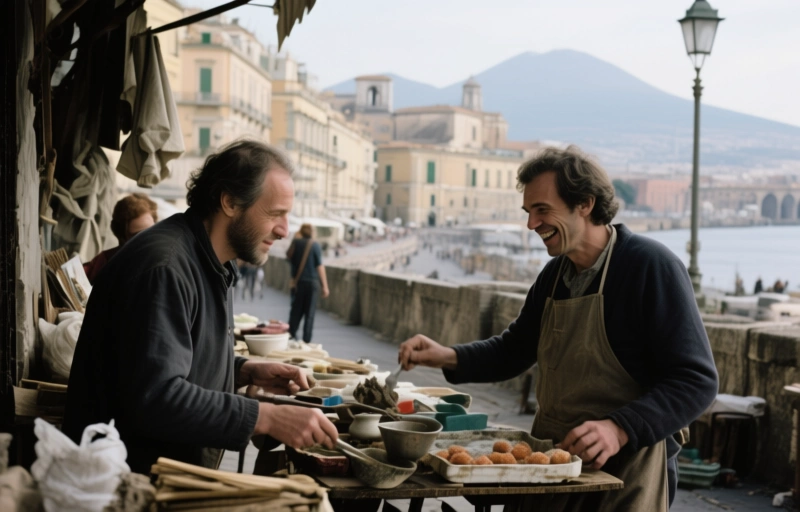
Reconsidering Jan van Stinemolen's 16th-century view of Naples not as an inaccurate map, but as a visual experience designed to evoke the feeling of the city through artistic perspective and literary influence.
Let's talk about how we look at old city views. You know, those historical drawings and maps. We often treat them like ancient Google Maps, judging their accuracy against modern standards. But what if that's missing the point entirely?
That's exactly what happens with Jan van Stinemolen's fascinating view of Naples from the 16th century. For years, scholars compared it to more "accurate" maps like those by Du Perac/Lafréry (1566) and Baratta (1627). They pointed out all the "mistakes" - the missing streets, the duplicated buildings, the shifted landmarks.
But here's the thing. What if Stinemolen wasn't trying to create a precise map? What if he was creating something entirely different?
### Seeing Naples Through Renaissance Eyes
Stinemolen's work isn't a map in the traditional sense. Think of it more like a visual poem. It's designed to evoke the experience of actually standing there, looking at Naples from the northern hills. You're not getting street-by-street directions. You're getting the feeling of the place.
Those so-called "distortions"? They start making sense when you stop looking for cartographic accuracy and start looking for emotional truth. The absence of the upper Decumanus, the way certain buildings appear twice or in slightly wrong places - these aren't errors. They're artistic choices.
He's trying to capture what it felt like to experience Naples, not just document its layout. It's the difference between a technical blueprint and a vivid memory.
### The City as Theater
Here's where it gets really interesting. Contemporary descriptions of Naples from the 16th and 17th centuries often described the city as a "theater." This wasn't just flowery language. It reflected how people actually experienced urban spaces.
Stinemolen's view embraces this theatrical concept completely. He doesn't give you one perfect vantage point. Instead, he combines multiple plausible viewpoints into a single, unified portrait. It's like he's saying, "Here are all the best seats in the house."
- **Multiple perspectives** create a more complete experience
- **Strategic omissions** focus attention on what matters
- **Artistic license** serves emotional authenticity over technical precision
This approach aligns perfectly with Naples' literary reputation at the time. The city wasn't just a place on a map - it was a character in stories, a setting for dramas, a source of inspiration.
### Why This Matters Today
We live in an age of satellite imagery and street view. Precision is cheap. But emotional resonance? That's still precious. Stinemolen's work reminds us that sometimes, capturing the spirit of a place is more valuable than recording every detail.
His view of Naples invites us to participate. It doesn't just show us a city - it asks us to imagine ourselves walking those streets, looking up at those buildings, feeling the atmosphere. The literary descriptions from his era did the same thing through words.
As one contemporary account might have said, "To know Naples is to experience it, not merely to chart it."
When we look at historical city views through this lens, we stop seeing mistakes and start seeing intention. We move from criticism to understanding. Stinemolen wasn't a bad cartographer. He was a brilliant visual storyteller working in a different medium with different goals.
Next time you see an old city view that seems "inaccurate," pause for a moment. Ask yourself: What was the artist really trying to communicate? What experience were they trying to create? You might discover layers of meaning that pure geography could never reveal.