Jan van Stinemolen's Naples: A Visual Experience
Miguel Fernández ·
Listen to this article~3 min

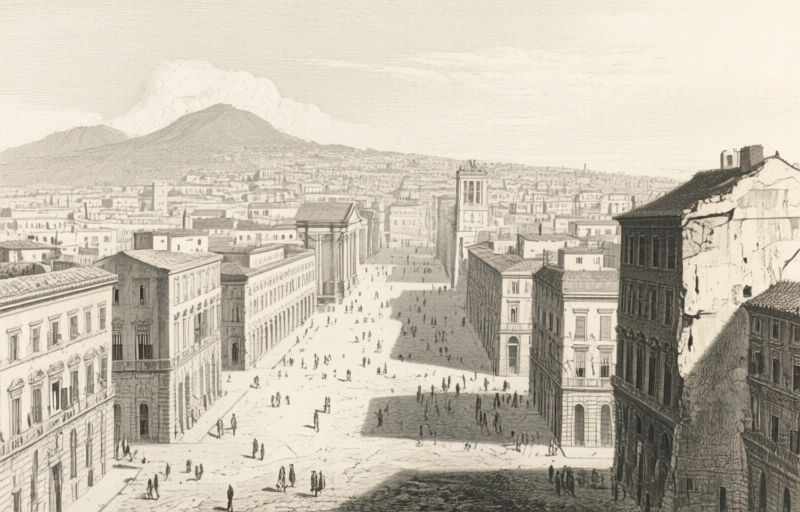
Jan van Stinemolen's view of Naples isn't a map—it's a visual experience. This analysis moves beyond topography to explore how his drawing evokes the city as a theatrical spectacle, rethinking its so-called distortions as intentional artistic choices.
Let's talk about Jan van Stinemolen's view of Naples. It's not your typical map. You see, most historical maps from that era, like the ones by Du Perac/Lafréry in 1566 or Baratta in 1627, were all about getting the topography right. They were practical tools, meant to show you where things were.
Stinemolen's drawing is something else entirely. Think of it less as a street guide and more as a visual device. It's designed to make you feel like you're standing there, taking in that panoramic vista yourself. It's about the experience, not just the coordinates.
### Rethinking the "Mistakes"
Now, here's where it gets interesting. Scholars used to look at this drawing and point out what they saw as errors. The upper Decumanus is missing. Some buildings appear twice, or they're not quite where they should be. We'd call those distortions or omissions on a standard map.
But what if they're not mistakes? What if they're intentional? When you stop comparing it to a strict cartographic record, these features start to make a different kind of sense. They might be part of how Stinemolen guides your eye and your imagination through the scene.
### The City as a Theatre
This idea connects deeply with how people wrote about Naples in the 16th and 17th centuries. Published descriptions of the city often used a powerful metaphor: they called Naples a "theatre." It wasn't just a place; it was a spectacle to be experienced.
Stinemolen's drawing captures that feeling perfectly. He sets his viewpoint up on the northern hills, which naturally frames the city below like a stage. But he doesn't give you just one seat in the audience.
- He combines multiple plausible viewpoints.
- He blends them into one unified portrait.
- He avoids privileging a single, fixed vantage point.
The result? You're not just looking *at* Naples; you're being invited to step into it. The drawing prompts you to engage with the urban space imaginatively, just like the literary accounts of the time did with words.
### More Than a Map
So, what's the big takeaway? Comparing Stinemolen's work directly to survey maps might lead us to miss the point. His visual rhetoric—his way of using images to communicate—was aligned with the city's literary renown. He was painting a portrait of an experience, not drafting a technical document.
It makes you wonder how many other historical images we've misunderstood because we judged them by the wrong standards. Sometimes, an artist isn't trying to show you every street. Sometimes, they're trying to make you feel the breeze off the bay and hear the distant hum of a city alive with stories. That's the real magic of Stinemolen's view of Naples.