Jan van Stinemolen: The Man Behind Naples' Panoramic View
Miguel Fernández ·
Listen to this article~4 min
Discover Jan van Stinemolen, a forgotten 16th-century artist who blended mapmaking with panoramic views in his spectacular 'View of Naples.' Uncover his mysterious life as a silversmith and naturalist.
You've probably never heard of Jan van Stinemolen. And honestly, that's kind of the point. He's one of those artists who slipped through the cracks of history, leaving behind only a handful of works and a lot of questions. But what he did leave us—the spectacular *View of Naples*—is worth diving into.
### Who Was Jan van Stinemolen?
Jan van Stinemolen lived from 1518 to 1582. He was born in Mechelen, a city in the Spanish Netherlands (modern-day Belgium). We know he spent time in Antwerp too, but his biography is mostly guesswork. He's not even mentioned in Karel van Mander's famous *Schilder-Boeck*, which is like the 16th-century who's who of artists. So where do we get his story? Archival records—bills, contracts, legal documents—that piece together fragments of his life.
What we do know: he was probably a silversmith and jeweller, like other members of his family. That was a solid, prosperous trade back then. But the religious wars tearing through his homeland may have affected him. Nothing of his metalwork survives, though. Only a few drawings remain, most attributed to him based on style alone.
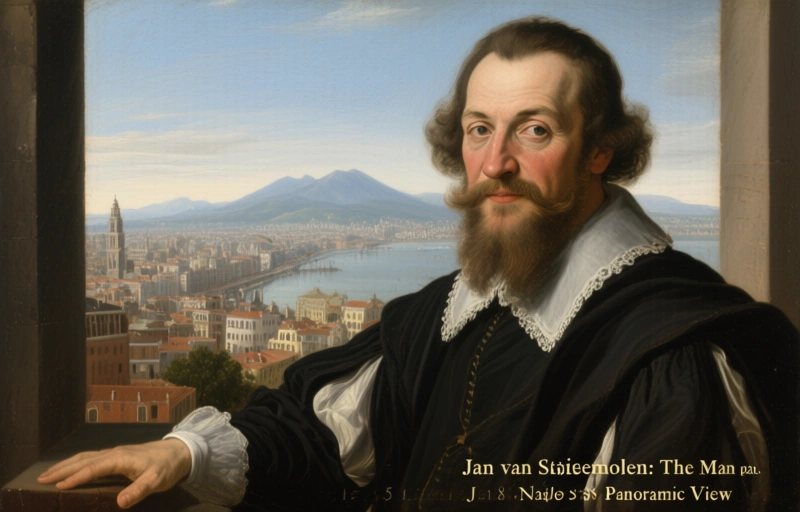
### The Naples Panorama: A Map and a Painting
Here's where it gets interesting. Stinemolen's *View of Naples* isn't just a pretty picture. It's a strange hybrid—a mix of topographical map and perspectival view. Imagine looking down at a city from above, but also seeing buildings and streets in a way that feels like you're standing right there. That's what he did.
- The panorama combines precise geographic detail with artistic perspective.
- It shows Naples' coastline, hills, and volcanic landscape.
- The drawing hints at a trip to Sicily, where he sketched volcanic terrain.
This fusion might have roots in Mechelen, where urban cartography was booming in the 16th century. Stinemolen would have been exposed to mapmakers who blended art and science. His fascination with volcanic landscapes—like Mount Vesuvius—shows up in other drawings too.
### What His Art Tells Us
Stinemolen's work isn't just about looking pretty. It reveals a mind curious about natural history. He was drawn to landscapes shaped by volcanic forces—lava flows, craters, ash. That's not typical for a silversmith. Most artists of his time focused on religious scenes or portraits. He went for the raw power of nature.
> "The characteristics of his panorama allow us to form further hypotheses about his artistic motivations and his interest in natural history."
Think about it: in the 1500s, few people traveled for pleasure. Stinemolen journeyed from the Netherlands to southern Italy, maybe even Sicily. That took guts and money. He wasn't just sightseeing—he was documenting. His drawings are like field notes from a scientist-artist.
### Why This Matters Today
Stinemolen's story reminds us that history is full of hidden gems. He wasn't a household name like Michelangelo or da Vinci, but his work offers a unique window into the past. It shows how art and science weren't separate back then—they were intertwined. A silversmith could also be a cartographer and a naturalist.
So next time you see an old map or a panoramic painting, think about Jan van Stinemolen. He's proof that you don't need fame to leave a mark. Sometimes, all you need is a curious mind and a steady hand.