Jan van Stinemolen's Naples: A Panoramic Experience
Miguel Fernández ·
Listen to this article~4 min
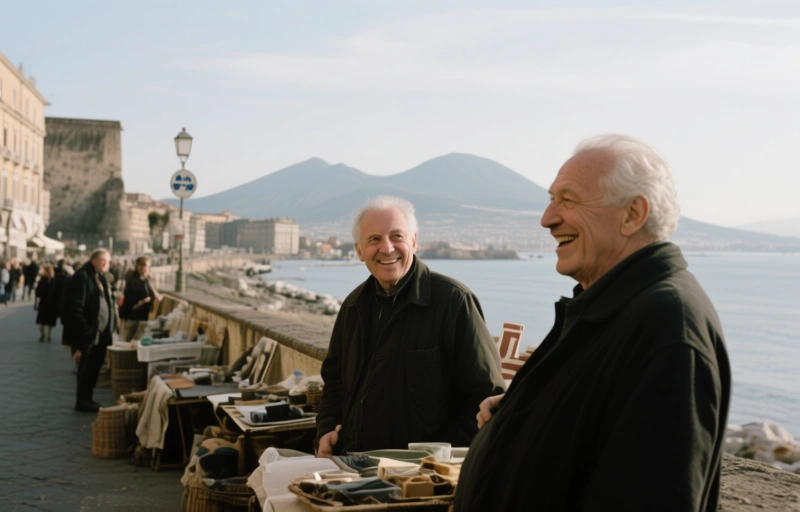
Reconsidering Jan van Stinemolen's view of Naples not as an inaccurate map, but as an artistic device designed to evoke the immersive experience of a panoramic vista, connecting visual art with literary tradition.
Let's talk about how we look at old maps and drawings. You know, we often treat them like historical blueprints—checking their accuracy, measuring their precision. But what if that's missing the point entirely?
That's exactly what happens with Jan van Stinemolen's remarkable view of Naples. For years, scholars have compared it to traditional maps like Du Perac/Lafréry's from 1566 or Baratta's from 1627. They've pointed out what's "wrong" with it. But here's the thing: Stinemolen wasn't trying to create a map. He was creating an experience.
### Seeing Naples Through Stinemolen's Eyes
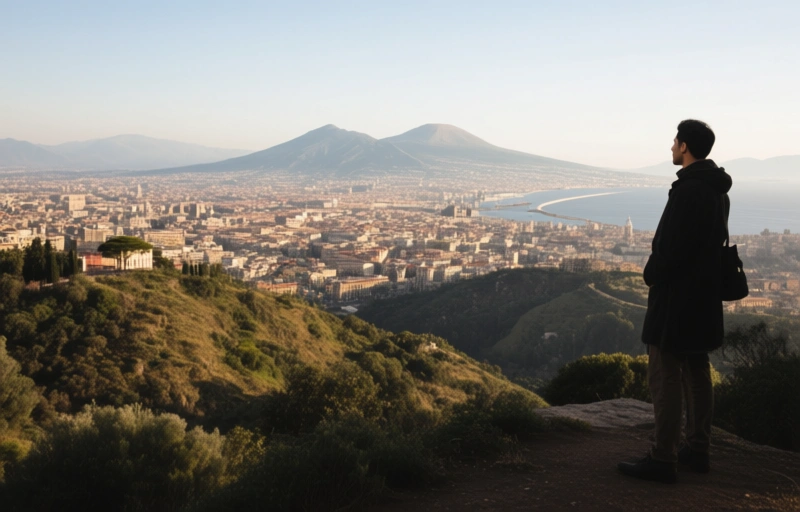
Imagine standing on those northern hills overlooking the city. You're not getting a single, fixed perspective. Instead, you're taking in multiple viewpoints, letting your eyes wander across the landscape. That's what Stinemolen captured—not a technical diagram, but the feeling of actually being there.
When you look at it this way, those so-called "distortions" start making sense. The missing upper Decumanus? The duplicated or shifted buildings? They're not mistakes. They're deliberate choices meant to evoke the experience of a panoramic vista.
It's like when you describe a place to a friend. You don't give them GPS coordinates. You talk about what it feels like to stand there, what catches your eye, how the space unfolds around you. That's visual storytelling.
### The City as Theater
Here's where it gets really interesting. Sixteenth- and seventeenth-century writers often described Naples as a kind of theater. The city's dramatic setting against the hills, the way it seemed to unfold before viewers—it was a spectacle.
Stinemolen's drawing taps right into that literary tradition. He doesn't privilege one perfect vantage point. Instead, he combines multiple plausible views into one unified portrait. It's like he's saying, "Here's how the city presents itself to someone experiencing it."
Think about it this way: when you visit a new city, you don't see everything at once from one spot. You piece together different views as you move through it. Your brain creates a composite image. That's what Stinemolen was doing artistically.
### Rethinking Historical Depictions
This approach changes how we engage with historical artwork. Instead of asking "Is this accurate?" we can ask "What experience was the artist trying to create?"
Consider these key differences between Stinemolen's work and traditional maps:
- Maps aim for topographic precision
- Stinemolen aimed for experiential truth
- Maps document locations
- Stinemolen evokes presence
- Maps are reference tools
- Stinemolen's drawing is an invitation
That last point is crucial. The drawing invites viewers to enter imaginatively into the urban space. It prompts you to mentally walk those streets, to imagine the life happening within those buildings.
### Why This Matters Today
In our age of satellite imagery and street view, we've become obsessed with perfect accuracy. But sometimes, the most truthful representation isn't the most precise one. Sometimes, capturing how a place feels matters more than capturing every measurement exactly.
Stinemolen understood this centuries ago. His view of Naples connects with the city's literary reputation during the Renaissance—a place celebrated not just for its geography, but for its atmosphere, its drama, its essence.
As one contemporary observer might have put it: "The true map of a city is written in the experience of its visitors, not just the measurements of its streets."
Next time you look at historical artwork, try this: don't just see what's there. Feel what the artist wanted you to experience. That shift in perspective can reveal layers of meaning we often miss when we're too focused on factual accuracy.
Stinemolen's Naples isn't just a depiction of a city. It's an invitation to see—and feel—history differently.