Jan van Stinemolen's Naples: A Panoramic Experience
Miguel Fernández ·
Listen to this article~4 min
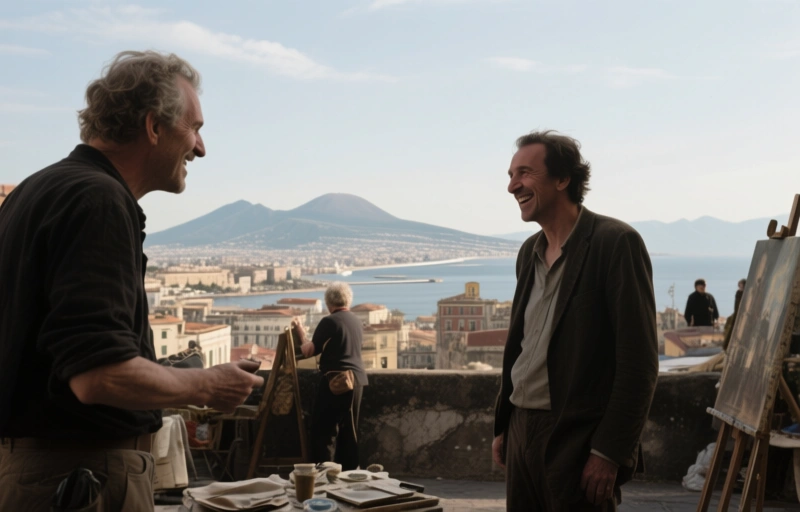
Explore Jan van Stinemolen's 16th-century view of Naples not as a map, but as an immersive panorama. This analysis reinterprets its 'errors' as deliberate artistic choices to evoke the city's theatrical beauty.
Let's talk about a drawing that's more than just a map. It's a window into how people *felt* about a city. Jan van Stinemolen's view of Naples from the 16th century isn't trying to be a perfect street guide. It's something richer. It's an invitation to experience the city as a breathtaking panorama, not just a collection of streets.
Think about it. When you look at a modern map, you're looking for directions. But when you stand on a hill and take in a view, you're looking for an *experience*. That's what Stinemolen was after. He wasn't competing with the precise topographical maps of his time, like those by Du Perac/Lafréry (1566) or Baratta (1627). He was doing something completely different.
### Rethinking the "Mistakes"
For years, art historians looked at Stinemolen's work and saw errors. Where's the upper Decumanus? Why are some buildings duplicated or shifted out of place? It's easy to label these as mistakes if you're only comparing it to a surveyor's map.
But what if we change our perspective? What if these aren't errors, but deliberate choices? They might be visual cues designed to pull you, the viewer, into the scene. The absence of a street isn't an omission; it's a way to focus your eye on the dramatic sweep of the city against the bay. It's about feeling, not measuring.
### Naples as a Living Theater
This idea connects deeply with how people wrote about Naples in the 16th and 17th centuries. Writers of the time constantly described the city as a grand "theatre," a stage set against the hills and sea. Stinemolen's drawing captures that exact sentiment. He doesn't give you one perfect, privileged vantage point. Instead, he combines multiple plausible views from the northern hills into one unified portrait.
It's like he's stitching together the best parts of a long, slow walk along the ridge. You get the sense of the city unfolding below you. This technique wasn't just artistic flair; it was in tune with the city's booming literary reputation. Naples wasn't just a place on a map—it was a character in stories, a source of inspiration.
### A Different Way to See
So, how should we engage with this work today? Don't look for street names. Try to see it as a 16th-century viewer might have.
- **Imagine the journey:** The drawing prompts you to mentally walk into the urban space, to explore it with your imagination, not your feet.
- **Feel the panorama:** It evokes the sensation of standing on a high point, the whole city laid out like a precious tapestry.
- **Embrace the rhetoric:** The visual choices are part of a persuasive language, convincing you of Naples's grandeur and theatrical beauty.
This shift in understanding is crucial. It moves us from cold analysis to warm appreciation. As one scholar might have put it, "The map tells you where you are. The view tells you how it feels to be there."
That's the real power of Stinemolen's work. It's a masterclass in emotional cartography. It reminds us that the most accurate depiction of a place isn't always the most measured one. Sometimes, it's the one that captures its soul. For historians and enthusiasts, this opens up a whole new way to analyze city views—not as failed maps, but as successful experiences.