Jan van Stinemolen's Naples: A Panoramic Experience
Miguel Fernández ·
Listen to this article~4 min
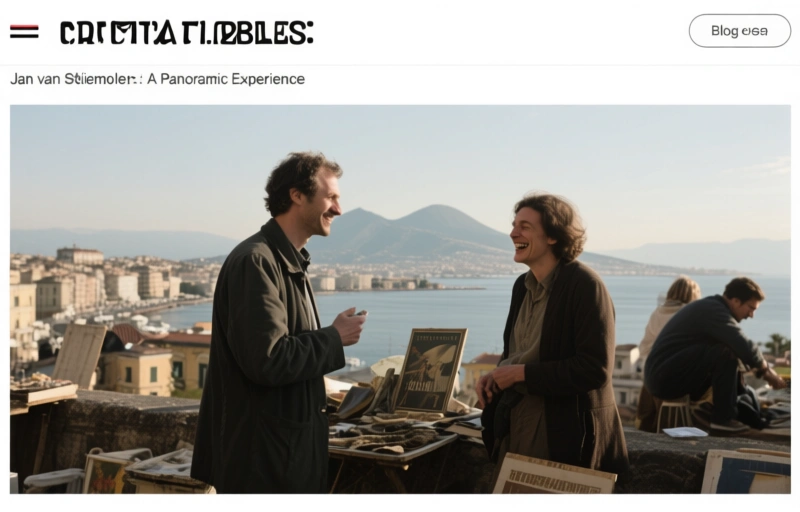
Jan van Stinemolen's 16th-century view of Naples isn't a map—it's an immersive experience. This analysis moves beyond cartography to explore how his drawing evokes a panoramic vista, inviting viewers to imaginatively enter the urban space.
Let's talk about Jan van Stinemolen's view of Naples. It's not your typical map. You know, the kind you'd use to find your way around. It's something else entirely. This drawing from the sixteenth century invites you to *experience* the city, not just locate it.
We often compare old city views to historical maps. That's the traditional approach. But with Stinemolen's work, that comparison falls short. Maps by Du Perac/Lafréry (1566) and Baratta (1627) were made for topography. They're about accuracy, about plotting points. Stinemolen had a different goal.
### Seeing Naples as a Panorama
His drawing is a visual device. Think of it like a postcard from the past, but one that captures a feeling. It evokes the experience of standing on those northern hills and taking in the whole scene. It's less about documenting every street and more about making you feel like you're there.
This changes how we see the so-called 'mistakes.' For years, scholars pointed out distortions. They noted the absence of the upper Decumanus. They saw duplicated or displaced buildings as errors. But what if they weren't errors at all?
### Reconsidering the 'Distortions'
Within this new framework, these features get a second look. The omissions and shifts might be intentional. They could be part of creating that panoramic vista, that unified portrait of the city. It's like an artist choosing what to include in a landscape painting to guide your eye.
The parallel with published descriptions of Naples from the same era is fascinating. Sixteenth- and seventeenth-century writers didn't just list landmarks. They described atmospheres, sensations, and the city's theatrical nature. Stinemolen's visual approach does the same thing.
It prompts you, the viewer, to engage differently. You're not just looking *at* Naples; you're being invited to enter it imaginatively. The drawing becomes a gateway.
### The City as a Theatre
That idea of the city as a 'theatre' is key. It was a recurrent theme in early modern accounts. Naples, with its dramatic hills and bay, was seen as a natural stage. Stinemolen's work captures this perfectly.
He doesn't give you one privileged vantage point. Instead, he combines multiple plausible views. It's as if you're turning your head slowly, taking in the whole sweep of the scene from the hills. This technique aligns with his visual rhetoric and the city's immense literary fame at the time.
Here’s what makes this view so unique compared to standard maps:
- It prioritizes experiential feeling over cartographic precision.
- It uses composite viewpoints to create a cohesive whole.
- It engages the viewer's imagination, not just their sense of direction.
- It reflects the literary and cultural image of Naples as a dramatic, living space.
One contemporary writer described the experience of seeing Naples from the hills, noting how the city seemed to unfold like a story beneath them. Stinemolen's drawing tries to bottle that exact sensation.
So, next time you look at an old city view, ask yourself: is it a map, or is it an invitation? With Stinemolen's Naples, the answer is clearly the latter. It's a masterpiece of suggestion, designed to make you feel the city's pulse centuries after it was drawn. That's a powerful legacy for any piece of art.