Jan van Stinemolen's Naples: A Panoramic Experience
Miguel Fernández ·
Listen to this article~3 min
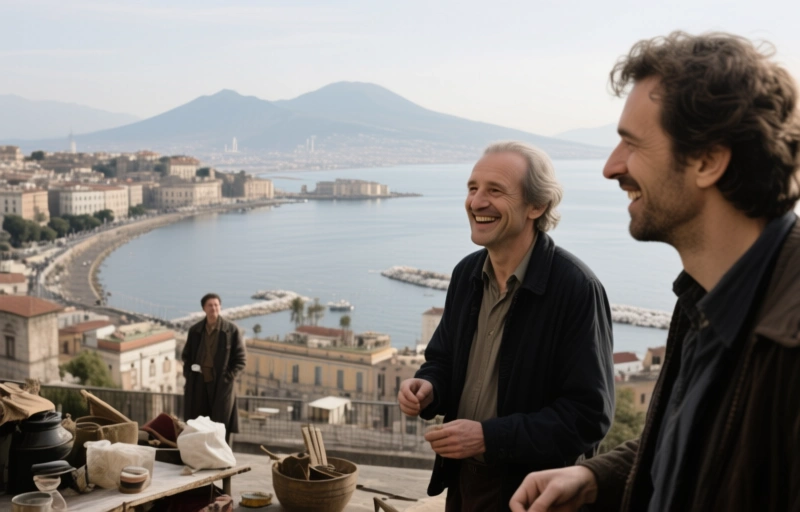
Re-examining Jan van Stinemolen's view of Naples as an experiential panorama, not a map. This shift explains its unique features and connects it to the city's literary fame.
Let's talk about Jan van Stinemolen's view of Naples. It's not your typical map. For years, scholars have compared it to historical cartography, like the maps by Du Perac/Lafréry from 1566 or Baratta's from 1627. Those were made with a topographical purpose—they wanted to show you where things were, plain and simple.
But Stinemolen's drawing? It's something else entirely. It feels more like a visual device, a tool designed to make you, the viewer, experience a panoramic vista. It's less about pinpoint accuracy and more about evoking a feeling. That's a pretty big shift in how we look at this piece.
### Rethinking the "Mistakes"
This new perspective changes everything. Features we once called distortions or omissions suddenly make sense. Take the absence of the upper Decumanus, or the way some buildings seem duplicated or out of place. If you're judging it as a map, those are errors. But if you see it as an experiential panorama, they're deliberate choices.
They're part of a visual rhetoric meant to guide your eye and your imagination. It's like the artist is saying, "Come, walk with me through this city." He's not giving you a satellite photo; he's offering you a curated tour.
### A Literary Cityscape
Here's where it gets really interesting. When you look at sixteenth- and seventeenth-century published descriptions of Naples, you start to see parallels. The city had a huge literary reputation. Writers described it as a living, breathing entity.
Stinemolen's work taps into that same spirit. His drawing doesn't just show buildings; it prompts you to enter the urban space imaginatively. You're not just observing; you're participating. The piece becomes a bridge between visual art and the written word.
### The City as a Theatre
One of the most powerful ideas in early modern accounts of Naples is the city as a "theatre." It's a recurring theme. Stinemolen captures this perfectly by adopting multiple viewpoints from the northern hills. He doesn't give you one perfect, privileged vantage point.
Instead, he combines several plausible views into one unified portrait. It's like sitting in a theatre and seeing the stage from different angles all at once. The city unfolds in layers.
- It's a composite of experiences.
- It prioritizes feeling over fact.
- It invites personal interpretation.
This approach aligns perfectly with the city's literary fame in the sixteenth century. Naples wasn't just a place on a map; it was a story, a sensation, a character in its own right. Stinemolen got that. His work is less about documenting geography and more about capturing essence. He asks us to see Naples not just as it was, but as it was felt and imagined. That's the real magic of it.