Jan van Stinemolen's Naples: A Panoramic Experience
Miguel Fernández ·
Listen to this article~3 min
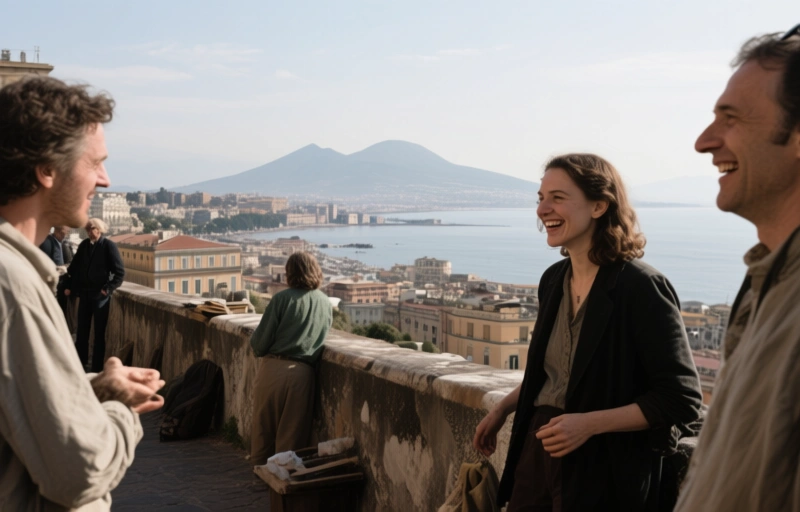
Re-examining Jan van Stinemolen's view of Naples not as a flawed map, but as an immersive panorama designed to evoke the experience of the city, aligning with its literary fame.
Let's talk about how we look at old city views. For years, scholars have treated Jan van Stinemolen's 16th-century drawing of Naples like a faulty map. They'd line it up with cartographic works by Du Perac/Lafréry (1566) or Baratta (1627) and point out all the 'mistakes.' But what if we're asking the wrong question? What if this drawing wasn't meant to be a precise street guide at all?
I think Stinemolen was after something deeper. He wasn't just documenting topography; he was trying to capture the *experience* of seeing Naples. Imagine standing on those northern hills, taking in that breathtaking panorama. That's the feeling he wanted to evoke.
### Rethinking the 'Mistakes'
When you stop comparing it to a map, the so-called errors start to make a different kind of sense. The missing upper Decumanus? The duplicated or shifted buildings? These aren't sloppy inaccuracies. They're deliberate choices in a visual composition designed to pull you into the scene.
It's like he's saying, 'Don't just look *at* the city. Imagine yourself walking *through* it.' This approach aligns perfectly with how 16th and 17th-century writers described Naples. They weren't giving GPS coordinates; they were crafting literary journeys.
### The City as a Theatre
This is where it gets really interesting. Early modern accounts often called Naples a 'theatre.' Stinemolen's drawing embraces that idea completely. He doesn't give you one perfect, god's-eye view. Instead, he combines multiple plausible perspectives from those hillside vantage points.
The result is a unified portrait that feels more real than a technically perfect map ever could. It's a collage of experiences, stitched together to convey the city's grandeur and complexity. This wasn't about recording every street—it was about capturing the city's soul and its formidable literary reputation.
So, what can we learn from this shift in perspective? For professionals working with historical visual materials, it's a crucial reminder:
- **Context is everything.** A drawing's purpose defines how we should interpret it.
- **'Accuracy' depends on the goal.** Topographical precision and emotional resonance are different kinds of truth.
- **Interdisciplinary connections matter.** Understanding the literary culture of the time explains the artistic choices.
> "Stinemolen's work invites us not to measure, but to imagine. It's a doorway into the 16th-century mind."
By viewing this drawing as a panoramic experience rather than a failed map, we unlock its true value. It becomes a conversation between the artist, the city, and the viewer across centuries. That's the real magic of archival work—finding those human connections in the details everyone else called errors.