Jan van Stinemolen's Naples: A Panoramic Experience
Miguel Fernández ·
Listen to this article~3 min
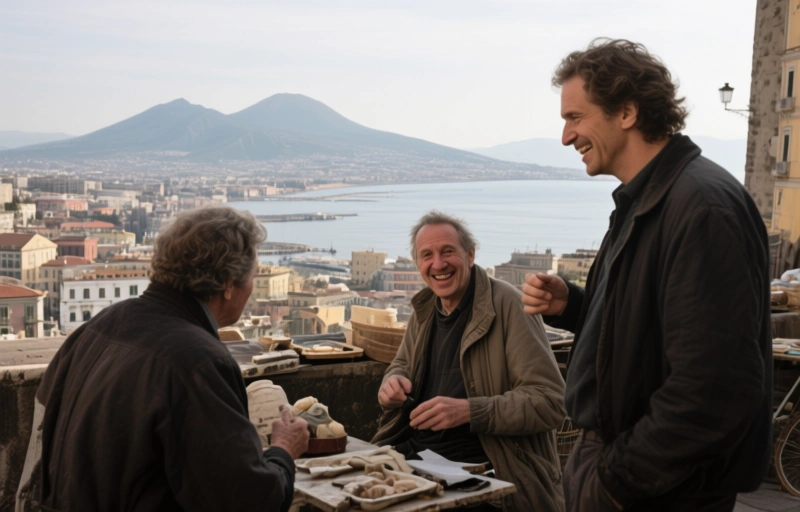
Re-examining Jan van Stinemolen's view of Naples not as a flawed map, but as an immersive visual experience designed to evoke the city's literary fame and panoramic grandeur.
Let's talk about Jan van Stinemolen's view of Naples. It's not your typical map. Most scholars have spent years comparing it to historical cartography, but that's missing the point entirely. We need to look at it differently. This drawing isn't trying to be a precise topographical guide like the maps by Du Perac/Lafréry from 1566 or Baratta from 1627. Those were made for navigation and measurement. Stinemolen's work is something else—it's a visual device designed to make you *feel* like you're standing there, taking in the whole breathtaking panorama.
### Rethinking the "Mistakes"
Here's where it gets interesting. For ages, art historians pointed out what they saw as errors in Stinemolen's depiction. They'd say, "Look, the upper Decumanus is missing!" or "Why is this building duplicated or shifted out of place?" We've been judging it by the wrong standards. If we stop seeing it as a failed map and start seeing it as a crafted visual experience, these features aren't mistakes. They're deliberate choices. They're part of the artist's toolkit for creating a specific feeling, for guiding your eye and your imagination through the cityscape.
### The City as a Theatre
This idea connects deeply with how people wrote about Naples in the 16th and 17th centuries. Published descriptions from that era often talked about the city as a kind of "theatre." It was a recurring theme—a topos, as scholars say. Stinemolen's drawing brings that literary concept to life visually. By setting the viewpoint from the northern hills, he frames the city just like a stage. But he doesn't give you just one seat in the audience. He combines multiple plausible views into one unified portrait. You're not stuck with a single, privileged vantage point. Instead, you get to explore.
This approach invites a different kind of engagement. It doesn't just show you a city; it prompts you to enter it imaginatively. You're not a passive observer checking coordinates. You're a visitor, letting your mind wander through the streets and up the hills. The drawing becomes a portal.
### A Conversation Between Art and Literature
What Stinemolen was doing aligns perfectly with the city's massive literary renown at the time. Naples wasn't just a place on a map in the sixteenth century; it was a symbol, a source of inspiration, a character in countless stories. His visual rhetoric—that artistic language of multiple viewpoints and experiential composition—was in direct conversation with that fame. He wasn't documenting geography for a bureaucrat. He was evoking the *idea* of Naples for a cultured viewer who knew its legends and its lore.
So, what does this mean for us today? It's a reminder to meet historical art on its own terms. When we analyze a work, we have to ask: what was it trying to *do*? What experience was it designed to create? Sometimes, the so-called "flaws" are the most revealing parts. They show us the artist's priorities. In Stinemolen's case, his priority was immersion over measurement, feeling over fact. And in doing so, he created a far more enduring and evocative portrait of a legendary city.