Jan van Stinemolen: The Lost Artist Behind Naples'…
Miguel Fernández ·
Listen to this article~4 min
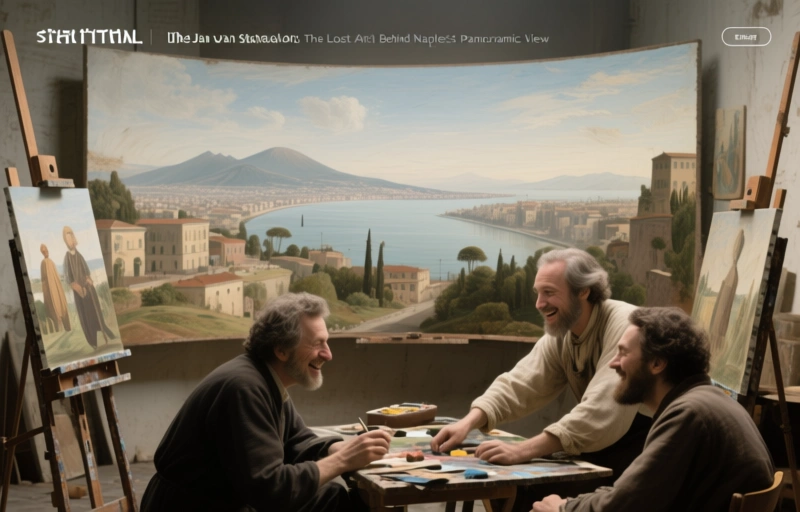
Discover Jan van Stinemolen, the 16th-century artist and silversmith whose life remains a mystery. Known for his spectacular panoramic View of Naples, he blended map-making with artistry, leaving a legacy that challenges how we see historical landscapes.
Ever heard of Jan van Stinemolen? Probably not. And that's exactly what makes this 16th-century artist so fascinating. He's like a ghost in art history—barely mentioned in the major records, yet he left behind one spectacular masterpiece that makes you wonder what else we've missed.
Jan van Stinemolen lived from 1518 to 1582, and honestly, piecing together his life feels like detective work. He doesn't even appear in Karel van Mander's famous *Schilder-Boeck*, which was basically the who's who of artists back then. So historians have had to dig through old archives, and even then, the picture remains incomplete.
### Where Did He Come From?
Most records place him in the Spanish Netherlands—first in his hometown of Mechelen, then later in Antwerp. But here's where it gets interesting. We know he spent time in Naples and southern Italy. One of his drawings even hints at a trip to Sicily. The exact dates? Those are still fuzzy. It's like trying to follow someone's shadow.
What's clear is that art wasn't his only gig. Like many in his family, he was primarily a silversmith and jeweler. That was a pretty lucrative trade back then, though the religious wars in his homeland probably made things complicated. The irony? Not a single piece of his metalwork has survived. All that craftsmanship, lost to time.
### What Actually Survived?
Here's what we do have—and it's pretty remarkable. Apart from his famous *View of Naples*, only a handful of drawings remain. Most are attributed to him based on style alone. That panoramic view of Naples is really something special. It's not just a painting; it's this unique blend of a topographical map and a perspectival view. You get the accuracy of a map with the immersive feel of standing right there.
Where did this approach come from? Well, it might have roots in Mechelen. That city was a hub for urban cartography in the 1500s. They were masters at mapping cities, and Stinemolen seems to have brought that precision into his art.
### More Than Just Pretty Landscapes
Look closer at his drawings, and you'll notice something. This guy was fascinated by landscapes shaped by volcanic forces. You can see it in the way he captured terrain—there's a real interest in how nature carves the earth. That panoramic view isn't just a pretty picture; it's a document. It lets us ask questions about what drove him as an artist.
Was he motivated by pure artistry? A love for natural history? A desire to document? The characteristics of that panorama open the door to all sorts of hypotheses. In many ways, Stinemolen represents countless artists history has overlooked. Talented individuals who worked, created, and then nearly vanished from the record.
- **The Mystery:** No contemporary biography, no definitive catalog of work.
- **The Trade:** A successful silversmith in a turbulent religious period.
- **The Legacy:** One major panoramic masterpiece and a few attributed drawings.
- **The Technique:** A fusion of map-making precision and artistic perspective.
It makes you think about how many other 'Stinemolens' are out there—artists we'll never know, whose work might be hiding in plain sight. His story reminds us that history is full of gaps, and sometimes the most interesting figures are the ones whispering from the margins.
As one art historian put it, 'Stinemolen's work asks us to look differently, to see the map in the view and the view in the map.' That's his real contribution. He challenges our categories. So next time you see an old panorama, maybe wonder about the hands that made it. The story might be just as layered as the artwork itself.