Jan van Stinemolen: The Lost Artist Behind Naples'…
Miguel Fernández ·
Listen to this article~4 min
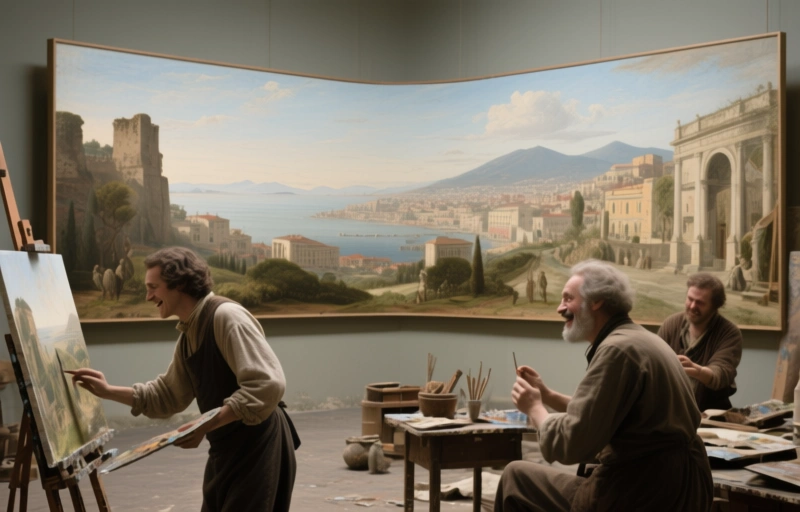
Explore the mysterious life of Jan van Stinemolen (1518–1582), the unknown artist behind the spectacular panoramic View of Naples. A silversmith turned cartographic visionary.
Jan van Stinemolen lived from 1518 to 1582, and honestly, he's one of those artists who slipped through the cracks of history. He's fascinating precisely because he's so unknown. You won't find him in Karel van Mander's famous *Schilder-Boeck*, the go-to source for artists of his time. So, piecing together his life is a bit like detective work, relying on scattered archival records that leave us with an incomplete picture.
We know he was from the Spanish Netherlands. His story starts in his hometown of Mechelen and later moves to the bustling art center of Antwerp. But here's where it gets murky—his time in Italy. He definitely spent time in Naples and southern Italy, and we can guess he visited Sicily from clues in his drawings. The exact dates, though? They're lost to time.
### The Silversmith Who Painted a Masterpiece
Like many in his family, Stinemolen's day job was likely as a silversmith and jeweler. It was a prosperous trade in the 16th century, a good way to make a living. But his life wasn't all about crafting precious metals. The religious wars sweeping through his homeland probably affected him deeply, adding a layer of turmoil to his personal story.
The real twist is that none of his metalwork survives. Not a single goblet or engraved pendant. What we have left is something entirely different: his art on paper. Apart from one spectacular piece, only a handful of drawings remain, attributed to him mostly because of their style.
### The Spectacular View of Naples
That one spectacular piece is the *View of Naples*. It's not just a simple drawing; it's a unique hybrid. Stinemolen blended a detailed topographical map with a sweeping perspectival view. It's as if he wanted to give you the lay of the land *and* make you feel like you were standing there, taking it all in.
Where did this innovative approach come from? It might have roots right in Mechelen. In the 1500s, Mechelen was a hub for urban cartography—the science and art of mapping cities. Stinemolen would have been surrounded by this culture of precise, detailed city views, and he clearly absorbed those lessons.
### A Fascination with Volcanic Landscapes
Looking at his other drawings, a clear theme emerges. Stinemolen was captivated by landscapes shaped by raw, volcanic force. You can see it in the way he depicted terrain. It wasn't just about pretty scenery for him; it was about understanding the powerful natural forces that sculpted the earth.
This leads us to some interesting questions about the man himself. The characteristics of his great panorama let us form a few hypotheses:
- **Artistic Motivation:** Was he driven by a desire to document, to create a definitive record of a place?
- **Interest in Natural History:** His drawings suggest a mind curious about geology and how the world works, not just how it looks.
In the end, Jan van Stinemolen represents a tantalizing mystery. He was a craftsman, an artist, and possibly a keen observer of nature, all rolled into one. His biography is full of gaps, but his one major surviving work opens a window into a creative mind that merged map-making with artistry, and documentation with a sense of wonder. He reminds us that history is filled with brilliant people whose stories are only partially told, waiting in archives and on old sheets of paper for us to connect the dots.