Jan van Stinemolen: The Lost Artist Behind Naples'…
Miguel Fernández ·
Listen to this article~4 min
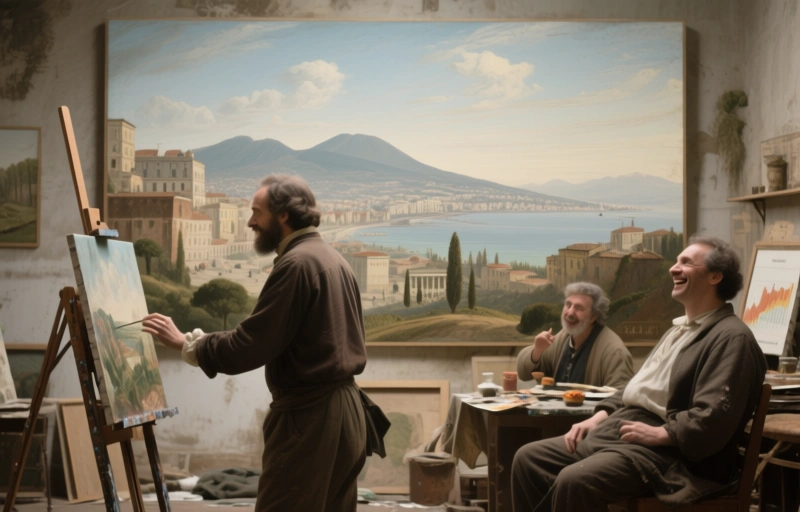
Explore the mysterious life and work of Jan van Stinemolen (1518–1582), the artist behind the spectacular View of Naples panorama. Discover how his background as a silversmith and his travels shaped his unique blend of cartography and art.
Let's talk about an artist who's been hiding in plain sight for centuries. Jan van Stinemolen lived from 1518 to 1582, and honestly, most people have never heard of him. That's because he doesn't show up in the famous art history books of his time. We're left piecing together his story from scattered records, and let me tell you, it's a fascinating puzzle.
### The Elusive Biography
Tracing Stinemolen's life is like trying to follow breadcrumbs through a forest. The archives place him firmly in the Spanish Netherlands—first in his hometown of Mechelen, then later in bustling Antwerp. But here's where it gets tricky: we know he spent time in Naples and southern Italy, maybe even Sicily. The exact dates? Those are lost to history. What's clear is that he came from a family of silversmiths and jewelers, a pretty lucrative trade back then. Though the religious wars probably made things complicated for him.
Think about that for a second. Here's a skilled craftsman, working with precious metals during one of Europe's most turbulent periods. It makes you wonder how his experiences shaped his art.
### The Surviving Works
Now, here's the heartbreaking part. Not a single piece of his silversmith work has survived. All those intricate creations, melted down or lost to time. What we do have is his spectacular *View of Naples* panorama and a handful of drawings. Most of those drawings are attributed to him based on style alone—there aren't many signatures or documents to confirm it.
That panorama though? It's something special. Stinemolen managed to blend a detailed topographical map with a beautiful perspectival view. It's like he couldn't decide between being a cartographer and a painter, so he became both.
### The Mechelen Connection
This unique approach might have roots in his hometown. Mechelen was a hub for urban cartography in the 16th century. The city was literally mapping itself while Stinemolen was growing up there. You can see that influence in how he approached landscapes—with both precision and artistry.
His drawings show something else too: a real fascination with landscapes shaped by volcanic forces. There's a raw power in those scenes, a sense of nature's overwhelming creativity. It makes you think he wasn't just documenting what he saw; he was trying to understand the forces that created it.
### Why His Work Matters Today
Looking at Stinemolen's panorama gives us more than just a pretty picture of old Naples. It lets us form some interesting hypotheses about his artistic motivations. Was he driven by scientific curiosity? A love for natural history? The desire to capture a moment in time before it disappeared?
Consider these key aspects of his surviving work:
- The technical precision of a mapmaker combined with an artist's eye
- A clear interest in geological formations and natural forces
- The blending of multiple perspectives into a single cohesive view
- The documentation of a specific place at a specific historical moment
As one art historian might say, "Stinemolen's work bridges the gap between science and art in ways we're still unpacking today."
### The Legacy of a Lost Artist
What's remarkable is how much we can learn from so little. A few drawings, one major panorama, and some archival fragments—that's what remains of Jan van Stinemolen's life work. Yet those fragments tell a story of curiosity, skill, and a unique vision.
He worked during a time of religious conflict, traveled between different cultures, and brought all those experiences to his art. His panorama isn't just a view of Naples; it's a window into how one artist saw the world. And honestly, that perspective feels more relevant than ever in our own visually saturated age.
We're left with questions, of course. What would his silverwork have looked like? How many other drawings have been lost? What conversations did he have with other artists and mapmakers? The mystery is part of what makes his story so compelling. Sometimes, what we don't know is just as important as what we do.