Jan van Stinemolen: The Lost Artist Behind Naples'…
Miguel Fernández ·
Listen to this article~4 min
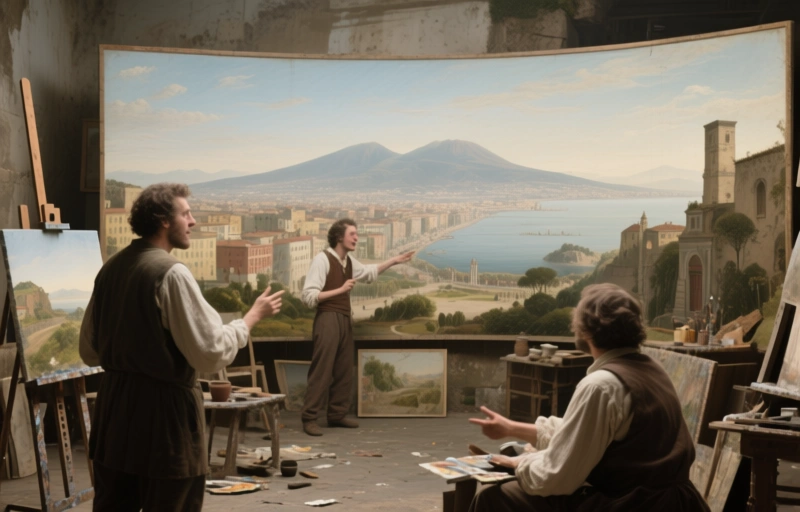
Explore the mysterious life and innovative art of Jan van Stinemolen (1518–1582), the Renaissance artist behind the spectacular panoramic View of Naples. Discover how he blended mapmaking with artistry.
Jan van Stinemolen (1518–1582) is one of those fascinating artists who slipped through the cracks of history. He's largely unknown today, and honestly, that's a real shame. When you dig into his story, you find a creative mind working at the intersection of art, cartography, and natural science during a turbulent time.
His biography is a puzzle we're still piecing together. He doesn't even get a mention in Karel van Mander's famous *Schilder-Boeck*, the go-to source for artists of his era. So we're left with scattered archival records that tell an incomplete story.
### Piecing Together a Life
What we do know is this: Stinemolen was active in the Spanish Netherlands. He started in his hometown of Mechelen and later moved to Antwerp. The timeline gets fuzzy when we try to pin down his travels to southern Italy. We know he was in Naples, and a trip to Sicily is hinted at in one of his drawings, but the exact dates? They're lost to time.
Like others in his family, he probably made his living as a silversmith and jeweler. That was a lucrative trade back then, though the religious wars sweeping through his homeland likely disrupted his work. Tragically, none of his metalwork survives today.
### The Spectacular View of Naples
What *has* survived is his masterpiece: the spectacular *View of Naples*. Apart from that panorama, we only have a handful of drawings attributed to him based on style. That makes the *View of Naples* incredibly precious—it's our main window into his artistic vision.
So what makes this panorama so special? Stinemolen did something pretty innovative. He blended a detailed topographical map with a sweeping perspectival view. It's not just a picture; it's a hybrid document that's both artistic and informational.
This unique approach might have roots in Mechelen, where urban cartography was really thriving in the 16th century. He would've been exposed to those cutting-edge techniques.
### A Fascination with Volcanic Landscapes
Looking at his drawings, one theme becomes clear: Stinemolen was captivated by landscapes shaped by volcanic forces. You can see it in the way he rendered terrain. It wasn't just about pretty scenery for him; there was a genuine interest in the raw power of nature and how it sculpts the world.
This leads us to some interesting questions about his motivations. Was he just an artist, or was he also a keen observer of natural history? The characteristics of his panorama suggest the latter. He seems to have been driven by a desire to document and understand the world, not just depict it.
Here's what we can gather about his artistic approach from the surviving work:
- He valued precision and detail, likely from his training as a silversmith
- He wasn't afraid to merge different disciplines—art, mapmaking, science
- He had a particular eye for geological formations and natural drama
It's a reminder that artists in the Renaissance often wore many hats. They were observers, documentarians, and innovators. Stinemolen's story, fragmented as it is, shows us that. His work bridges gaps between fields we often keep separate today.
We're left with hypotheses about what drove him. The religious turmoil of his time, his prosperous trade, his travels—all of it likely shaped the artist who created that singular view of Naples. He remains an enigma, but through that one panorama, we get a glimpse of a remarkable mind that saw the world in a unique, interconnected way.