Jan van Stinemolen: The Lost Artist Behind Naples'…
Miguel Fernández ·
Listen to this article~4 min
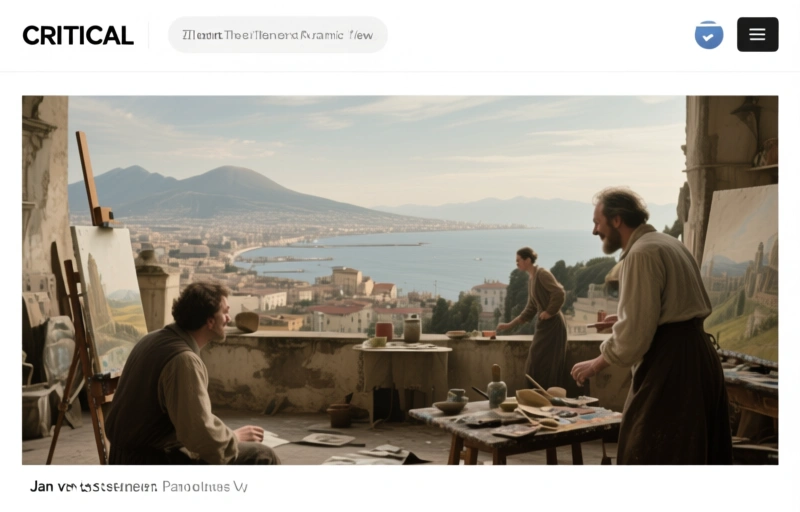
Explore the mysterious life and innovative art of Jan van Stinemolen (1518–1582), the Renaissance artist behind the spectacular panoramic View of Naples. Discover how he blended mapmaking with painting.
Jan van Stinemolen (1518–1582) is one of those fascinating artists who slipped through the cracks of art history. He's largely unknown today, and honestly, that's a real shame. When you dig into his story, you find a creative mind working at the intersection of art, cartography, and natural science during a turbulent time.
He's not even mentioned in Karel van Mander's famous *Schilder-Boeck*, which was basically the who's who of 16th-century Netherlandish art. So, piecing together his biography is like solving a puzzle with half the pieces missing. We have to rely on scattered archival records, and the picture they paint is incomplete.
### The Elusive Life of a Renaissance Craftsman
What we do know is this. Stinemolen was active in the Spanish Netherlands, first in his hometown of Mechelen and later in the bustling port city of Antwerp. The timeline of his travels to Italy is fuzzy. We know he spent time in Naples and southern Italy—a trip to Sicily is hinted at in one of his drawings—but the exact dates are lost to history.
Like others in his family, he probably made his living as a silversmith and jeweler. That was a prosperous trade back then, though the religious wars sweeping through his homeland likely disrupted his work and life. It's a reminder that artists never create in a vacuum; they're shaped by the world around them.
Here's the heartbreaking part: not a single piece of his metalwork survives today. All that remains of his artistic output is his spectacular *View of Naples* panorama and a handful of drawings attributed to him based on style. It makes you wonder what beautiful objects were lost.
### A Unique Vision: Map Meets Painting
So, what makes his *View of Naples* so special? Stinemolen did something pretty innovative. He blended a detailed topographical map with a sweeping perspectival view. You get the accuracy of a surveyor's plan combined with the artistic drama of a landscape painting. It's not just a picture; it's a document.
This unique approach might have roots in Mechelen, where urban cartography was really taking off in the 1500s. The city was a hub for mapmakers and artists who were rethinking how to represent space. Stinemolen seems to have absorbed those ideas and run with them.
### Drawn to Nature's Power
Looking at his surviving drawings, another theme emerges. The man was clearly fascinated by landscapes shaped by raw, volcanic force. You can see it in the way he depicted terrain. It wasn't just about pretty scenery for him; it was about understanding the powerful geological processes that created it.
This interest in natural history adds another layer to his work. His panorama of Naples isn't just a portrait of a city. It's a study of a place built in the shadow of Mount Vesuvius, a constant reminder of nature's immense power. The characteristics of his work let us form some interesting hypotheses:
- He was likely driven by both artistic and scientific curiosity.
- His training as a precise craftsman (a silversmith) informed his detailed approach.
- He was part of a broader Renaissance shift toward observing and documenting the natural world.
In the end, Jan van Stinemolen remains an enigmatic figure. But through his one major surviving work, we get a glimpse of a sophisticated mind that refused to be boxed into a single category. He was an artist, a mapmaker, and an observer of nature, all at once. His story reminds us that history is full of brilliant people whose legacies are fragile, surviving only by chance. It's worth taking a moment to appreciate them.