Jan van Stinemolen: The Lost Artist Behind Naples'…
Miguel Fernández ·
Listen to this article~4 min
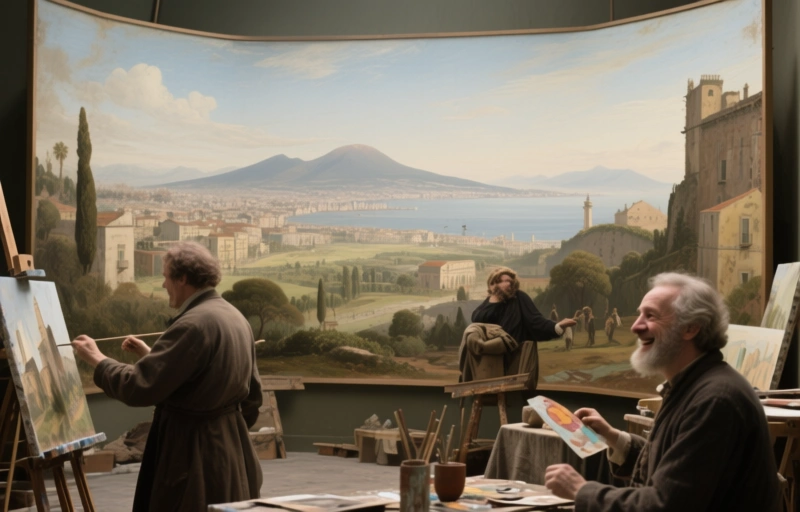
Explore the mysterious life of Jan van Stinemolen (1518–1582), the unknown artist behind the spectacular panoramic View of Naples. A silversmith turned cartographic innovator.
Jan van Stinemolen lived from 1518 to 1582, and honestly, he's one of those artists who slipped through the cracks of history. He's fascinating precisely because he's so unknown. You won't find his name in Karel van Mander's famous *Schilder-Boeck*, the go-to source for artists of that era. So, piecing together his life is a bit like detective work, relying on scattered archival records that leave us with an incomplete picture.
What we do know paints a portrait of a man moving between worlds. The records place him firmly in the Spanish Netherlands for most of his life. He started in his hometown of Mechelen and later moved to the bustling artistic hub of Antwerp. But his story gets murkier—and more interesting—when we look south.
### The Mysterious Italian Journey
His time in Naples and southern Italy is a historical puzzle. We know he went; a trip to Sicily is hinted at in one of his surviving drawings. But the exact dates? They're lost to time. This gap is frustrating for historians, but it also adds a layer of intrigue to his work. What did he see there that inspired him? Who did he meet?
It seems his primary trade wasn't painting grand panoramas. Like others in his family, Stinemolen was likely a silversmith and jeweler. In the 16th century, that was a lucrative and respected craft. Of course, living through the religious wars in the Netherlands couldn't have been easy, and that turmoil probably affected his life and work, even if we don't know the specifics.
Here's the real kicker: not a single piece of his metalwork survives today. All that's left of his artistic output is his spectacular *View of Naples* and a handful of drawings attributed to him based on style. It's a reminder of how fragile an artist's legacy can be.
### A Unique Blend of Art and Mapmaking
So, what makes his *View of Naples* so special? Stinemolen didn't just paint a pretty picture. He created a unique hybrid—a fusion of a detailed topographical map and a sweeping perspectival view. This wasn't a common approach. Scholars believe this innovative style might have roots right back in Mechelen, which was a center for urban cartography in the 1500s. He was essentially blending science and art on a single canvas.
Looking at his drawings, another passion becomes clear: a deep fascination with landscapes shaped by raw, volcanic power. This wasn't just about depicting scenery; it was an early interest in natural history and the forces that shape our world. His panorama of Naples, sitting in the shadow of Mount Vesuvius, is the perfect subject for such an artist.
- **The Lost Craftsman:** His primary career as a silversmith is confirmed by records, but none of that work remains.
- **The Sole Masterpiece:** The *View of Naples* stands alone, a breathtaking exception to his lost oeuvre.
- **The Cartographic Innovator:** He merged precise mapmaking with artistic perspective, a technique ahead of its time.
- **The Natural Historian:** His drawings reveal a keen interest in geology and volcanic landscapes.
The characteristics of his great panorama let us make some educated guesses. We can hypothesize about his artistic drives—was he documenting, exploring, or inventing? His work suggests a mind equally drawn to artistic beauty and scientific observation. In many ways, Jan van Stinemolen was a Renaissance man in the truest sense, even if history has been slow to remember him. His story reminds us that for every famous name, there are dozens of talented individuals whose stories are waiting to be rediscovered, one archival clue at a time.