Jan van Stinemolen: The Lost Artist Behind Naples'…
Miguel Fernández ·
Listen to this article~4 min
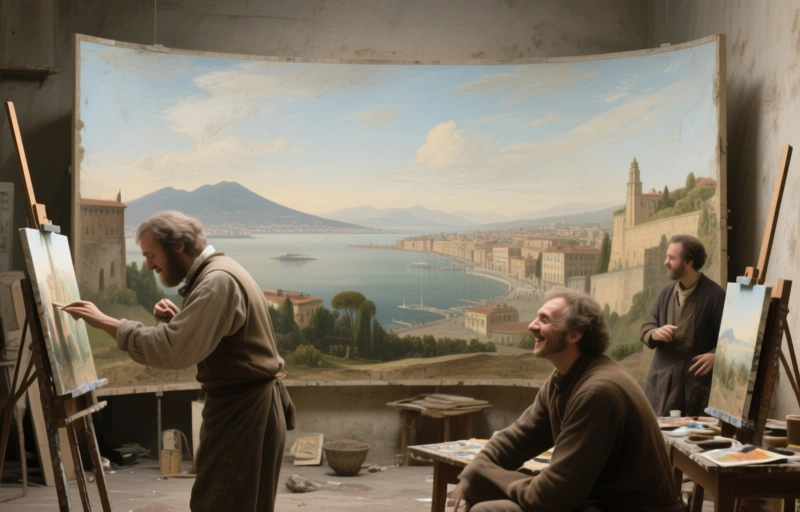
Explore the mysterious life of Jan van Stinemolen (1518–1582), the forgotten artist behind the spectacular panoramic View of Naples. A silversmith turned visionary, his work blends map-making with artistry.
Jan van Stinemolen lived from 1518 to 1582, and honestly, he's one of those artists who should be way more famous than he is. Most people have never heard of him, and that's a real shame. His story is like a puzzle with half the pieces missing—we have to piece together his life from old records and archives because he doesn't even get a mention in Karel van Mander's famous *Schilder-Boeck*, which was basically the who's who of artists back then.
What we do know paints an interesting picture. He was born in Mechelen, which was part of the Spanish Netherlands at the time. Later, he moved to Antwerp, another huge artistic hub. But here's where it gets fuzzy: we know he spent time in Naples and southern Italy, maybe even Sicily, but the exact dates? Those are lost to history.
### The Silversmith Who Became An Artist
Here's something that might surprise you. Stinemolen probably made his living as a silversmith and jeweler first. It was a good, solid profession—one that could make you a comfortable living. But the religious wars sweeping through his homeland likely disrupted that life. Isn't it funny how history's big events can redirect a single person's path?
The tragic part? Not a single piece of his metalwork survives today. All that skill, all that craftsmanship, just... gone. What we have left are a handful of drawings and one spectacular masterpiece: the *View of Naples*. Most of those other drawings are attributed to him based on style alone, which tells you how much detective work goes into art history.
### A Revolutionary Way of Seeing Naples
So, what's so special about this panorama? Stinemolen did something pretty genius. He merged a detailed topographical map with a beautiful, perspective-driven view. You get the accuracy of a map with the soul of a painting. It's like he couldn't decide between being a cartographer and a painter, so he became both at once.
This innovative approach might have roots right in his hometown. Mechelen was a center for urban cartography in the 1500s. They were mapping cities in new, detailed ways. Stinemolen would have grown up surrounded by that. He took that technical knowledge and fused it with an artist's eye.
### Drawn to Nature's Drama
Looking at his drawings, one passion becomes crystal clear: he was fascinated by landscapes shaped by raw, volcanic power. Think about that. In an age before geology was a formal science, he was captivated by how fire and earth could sculpt the world. His panorama of Naples isn't just a pretty picture of a city; it's a document of his curiosity about natural history.
We can make some educated guesses about what drove him. Maybe he wanted to capture not just *what* a place looked like, but *how* it came to be. His work lets us ask new questions about why artists create what they do. Was he documenting? Exploring? Making a statement? The clues are in the brushstrokes and the lines.
Here's what makes Stinemolen's story so compelling:
- He operated in the shadows of better-known masters.
- He bridged the gap between craft (silversmithing) and fine art.
- He combined technical mapping with artistic vision in a completely new way.
- His work hints at a deep, personal interest in the forces of nature.
In the end, Jan van Stinemolen remains an enigma. But through that one breathtaking view of Naples, he speaks to us across the centuries. He reminds us that sometimes, the most interesting figures aren't the famous ones, but the ones we have to search for, piece by piece, in the quiet corners of history.