Jan van Stinemolen: The Lost Artist Behind Naples'…
Miguel Fernández ·
Listen to this article~4 min
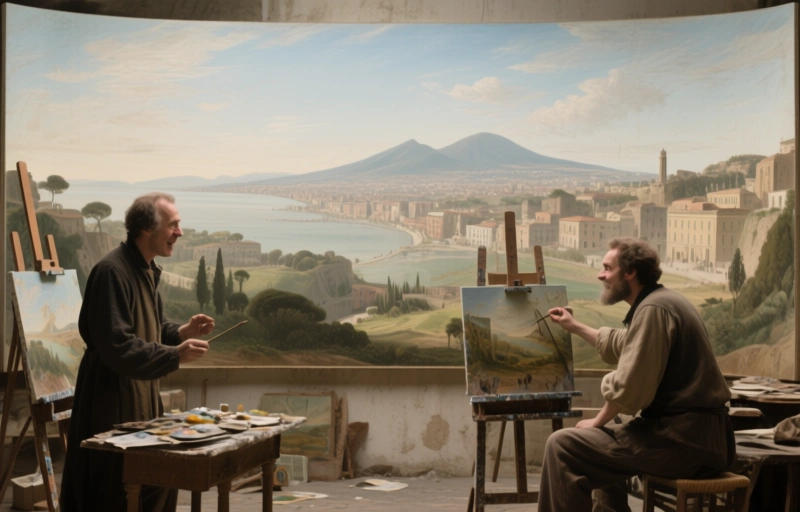
Explore the mysterious life and work of Jan van Stinemolen, the 16th century artist behind the spectacular View of Naples panorama. Discover how this silversmith turned cartographer blended art and science.
Jan van Stinemolen (1518–1582) is one of those fascinating artists who somehow slipped through the cracks of art history. He's largely unknown today, which is surprising when you consider the spectacular work he left behind. We have to piece together his biography from scattered archival sources, since he doesn't even appear in Karel van Mander's famous *Schilder-Boeck* – the go-to source for artists of his time. It's like trying to solve a puzzle with half the pieces missing.
What we do know paints an interesting picture. Stinemolen moved between the Spanish Netherlands cities of Mechelen and Antwerp, but his time in Naples and southern Italy remains shrouded in mystery. We can guess he traveled to Sicily from one of his drawings, but the exact dates? Those are lost to history. He came from a family of silversmiths and jewelers, which was a pretty prosperous trade back then. Though the religious wars in his homeland probably made things complicated.
### The Silversmith Who Became A Cartographer
Here's the strange part – nothing survives of his work as a silversmith. Not a single piece. All we have are a few drawings and that one spectacular *View of Naples* panorama. Most of these drawings are attributed to him based on style alone, which tells you how little documentation exists. It makes you wonder – was silversmithing his day job while art was his true passion? Or did circumstances force him to shift his focus entirely?
What's really fascinating is how he blended different approaches in his Naples panorama. He didn't just create a pretty picture – he merged topographic mapping with perspectival view in a way that was quite innovative for his time. This wasn't just artistic flair either. It likely grew from his roots in Mechelen, where urban cartography was really taking off during the 16th century. They were mapping cities with new precision, and Stinemolen absorbed that technical mindset.
### Volcanic Landscapes And Artistic Motivation
Look at his drawings, and you'll notice something recurring – a clear fascination with landscapes shaped by volcanic forces. This wasn't just about cre
ating beautiful scenes. He seemed genuinely interested in how nature itself sculpted the world. The characteristics of his panorama let us form some hypotheses about what drove him artistically:
- A deep interest in natural history and geology
- The desire to document places with both accuracy and artistry
- Blending scientific observation with aesthetic vision
- Capturing the relationship between human settlements and their natural environments
As one art historian noted, "Stinemolen's work sits at that fascinating intersection where mapmaking meets fine art, where documentation becomes poetry."
We're left with more questions than answers about Jan van Stinemolen. Why did such a talented artist leave so little behind? Was the *View of Naples* a passion project or part of a larger body of work that's been lost? How did his training as a silversmith influence his detailed, precise approach to landscape? These gaps in our knowledge actually make him more interesting in a way. He represents all those artists history nearly forgot, whose stories we have to reconstruct from fragments. His particular blend of technical mapping and artistic vision gives us a unique window into how 16th century artists were beginning to see – and represent – the world around them. Not just as something to paint, but as something to understand, measure, and marvel at.