Jan van Stinemolen: The Lost Artist Behind Naples'…
Miguel Fernández ·
Listen to this article~4 min
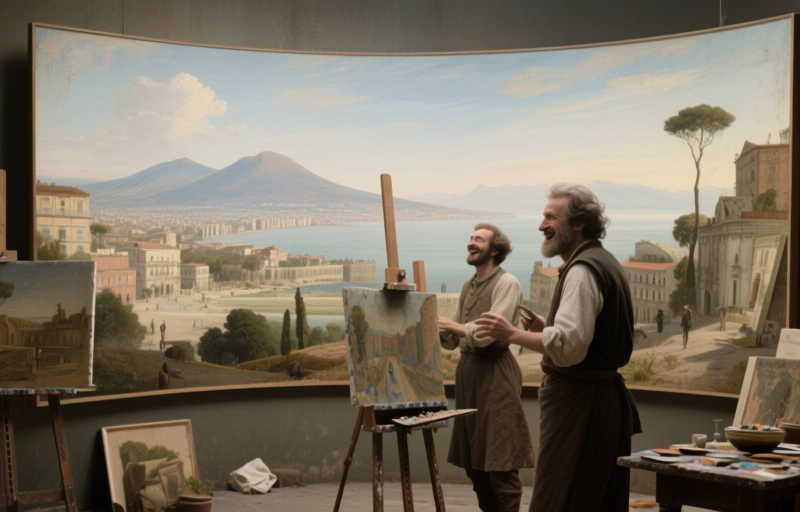
Explore the mysterious life and work of Jan van Stinemolen (1518–1582), the obscure artist behind the spectacular panoramic View of Naples. Discover how his background as a silversmith and travels through Italy shaped his unique artistic vision.
Jan van Stinemolen (1518–1582) is one of those fascinating artists who slipped through the cracks of art history. He's largely unknown today, which is a real shame when you consider what little we have of his work. His story isn't in the famous art books of his time—like Karel van Mander's *Schilder-Boeck*—so we have to piece his life together from scattered records. It's like trying to complete a puzzle with half the pieces missing.
What we do know paints an intriguing picture. He was from the Spanish Netherlands, living first in Mechelen and later in Antwerp. But here's where it gets interesting: he spent time in Naples and southern Italy, maybe even Sicily. The exact dates are fuzzy, but his drawings hint at travels that must have shaped his artistic vision.
### The Silversmith Who Became An Artist
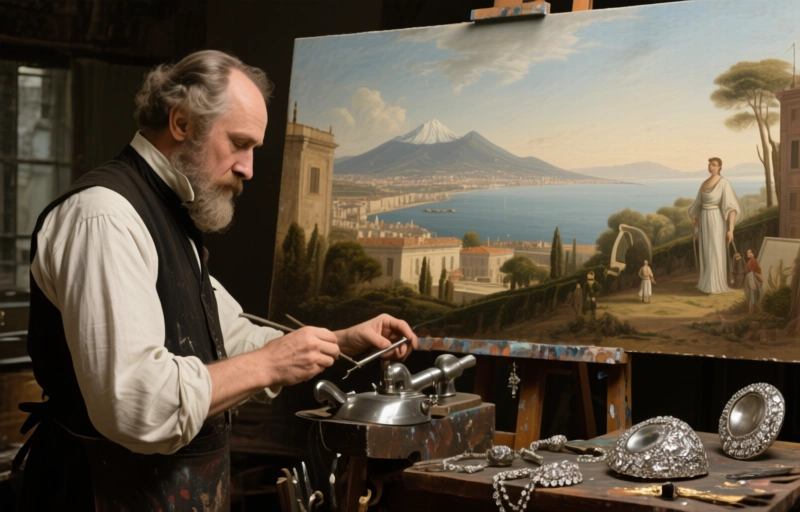
Stinemolen came from a family of silversmiths and jewelers, and that was probably his main profession. It was a good living, prosperous even, though the religious wars of his homeland likely caused some disruption. The strange thing is, none of his metalwork survives today. Not a single piece. All we have are a few drawings and one spectacular work: his *View of Naples*.
That panorama is really something special. It blends a topographical map with a perspectival view in a way that feels both accurate and artistic. You can almost feel him trying to capture not just what Naples looked like, but what it *felt* like to be there.
### Where Did His Unique Style Come From?
His hometown of Mechelen might hold some clues. In the 16th century, that city was a hub for urban cartography—map-making was flourishing there. Stinemolen probably absorbed those techniques, then combined them with an artist's eye for perspective. He wasn't just making a map; he was creating an experience.
Look at his drawings, and you'll notice something else: a clear fascination with landscapes shaped by volcanic forces. There's a sense of awe there, a genuine interest in how nature creates dramatic scenery. This wasn't just about pretty pictures; he was documenting natural history through art.
What makes his *View of Naples* so compelling is how it lets us peek into his artistic mind. We can start forming hypotheses about what drove him:
- Was he trying to merge scientific accuracy with artistic expression?
- Did his background in precise metalwork influence his detailed approach?
- How did his travels through Italy's dramatic landscapes shape his vision?
### The Mystery That Remains
Here's what I find most compelling about Stinemolen: we're left with more questions than answers. Why did such a talented artist remain so obscure? How much of his work has been lost to time? What would we learn if we discovered more of his pieces?
His story reminds us that art history isn't just about the famous names we all know. It's also about the talented individuals who, for whatever reason, didn't make it into the history books. Their work still matters, their vision still speaks to us, and their stories are still worth uncovering.
As one art historian put it, "Sometimes the most interesting artists are the ones you have to search for." Stinemolen certainly fits that description. His *View of Naples* stands as a testament to a unique artistic vision—one that blended map-making, perspective, and a genuine fascination with the natural world. It makes you wonder what else he created that we'll never get to see.