Jan van Stinemolen: The Lost Artist Behind Naples'…
Miguel Fernández ·
Listen to this article~5 min
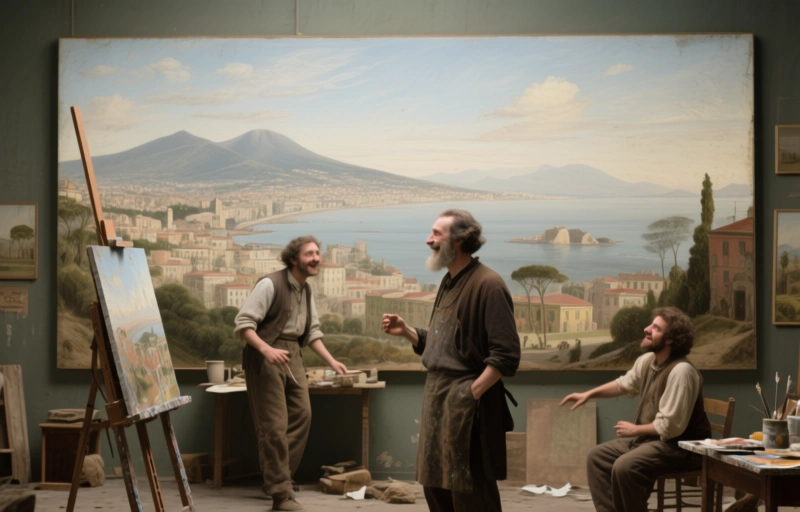
Explore the mysterious life and innovative art of Jan van Stinemolen, the 16th century artist behind Naples' spectacular panoramic view. Discover how his unique blend of cartography and perspective created Renaissance masterpieces.
Jan van Stinemolen (1518–1582) is one of those fascinating artists who somehow slipped through the cracks of art history. He's largely unknown today, which is a real shame when you consider what little we do know about him. His story feels like a puzzle with half the pieces missing, and that's exactly what makes him so intriguing to art professionals like us.
You won't find him mentioned in Karel van Mander's famous *Schilder-Boeck*, which was basically the who's who of 16th century Netherlandish artists. So historians have had to piece together his biography from scattered archival sources, and honestly, it's still incomplete. We're working with fragments here, trying to understand a life from paperwork and a handful of surviving works.
### The Journey of a Renaissance Craftsman
What we do know is that Stinemolen moved around quite a bit. The records show him first in his hometown of Mechelen, then later in Antwerp – both in the Spanish Netherlands. But here's where things get interesting: he definitely spent time in Naples and southern Italy. We can even infer a trip to Sicily from one of his drawings, though the exact dates of his Italian travels remain frustratingly unclear.
Like other members of his family, he was probably primarily active as a silversmith and jeweller. That was a prosperous profession in those days, though he may have been affected by the religious wars tearing through his homeland. It's one of those historical what-ifs – how might his work have developed differently if he'd stayed in more stable circumstances?
### The Mystery of the Missing Silverwork
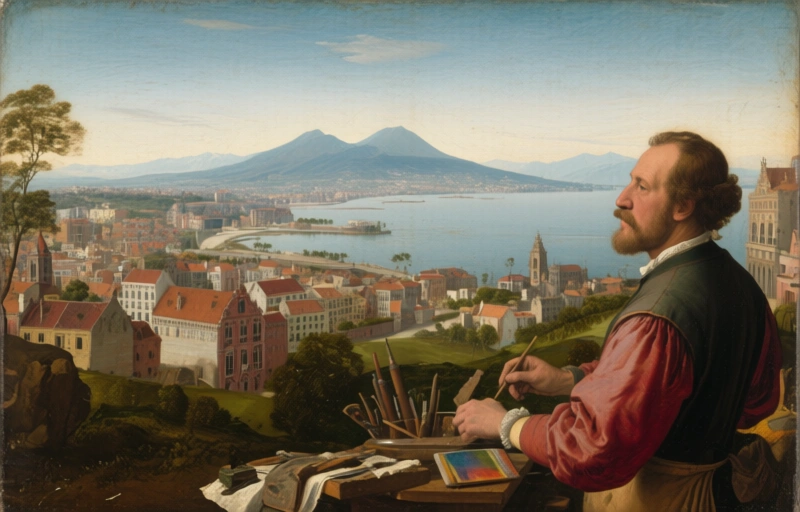
Here's something that keeps art historians up at night: nothing has survived of his work as a silversmith. Not a single piece. All we have is the spectacular *View of Naples* panorama and a few drawings attributed to him on stylistic grounds. It's like trying to understand a musician when you've only heard one song and seen some sheet music.
That panoramic view of Naples is really something special though. Stinemolen created this unique amalgamation of topographical map and perspectival view that feels ahead of its time. And you know what? That innovation might have its roots right back in Mechelen, where urban cartography was flourishing in the 16th century. He was bringing together different ways of seeing the world, literally mapping it while also presenting it as a lived experience.
### Reading Between the Lines of His Art
Looking at his drawings, you can see this clear fascination with landscapes shaped by volcanic forces. There's something about that raw, powerful natural creation that seems to have captured his imagination. And when you study the characteristics of his Naples panorama, you start forming hypotheses about his artistic motivations.
Was he just documenting what he saw, or was there something deeper going on? The way he blended map-making with artistic perspective suggests someone interested in both the scientific and the aesthetic. He wasn't just showing us Naples – he was showing us how to understand it, how to move through it visually.
Consider what his approach tells us:
- He valued accuracy in topography
- He understood the power of perspective in creating immersion
- He saw landscape as both geological fact and artistic subject
- He worked at the intersection of craft and fine art
As one art historian recently noted, "Stinemolen's work represents that fascinating Renaissance moment when art and science hadn't yet divorced – when observation and imagination worked hand in hand."
### Why Stinemolen Matters Today
For art professionals, Stinemolen represents those countless artists whose stories we've lost or only partially recovered. He reminds us that history is selective, that what survives isn't always what was most important in its time. His single surviving major work suggests an artist of real innovation, someone pushing boundaries in how we represent space and place.
His interest in natural history, evident in those volcanic landscapes, connects him to broader Renaissance currents of scientific inquiry. He wasn't just making pretty pictures – he was investigating the world through his art. And that Naples panorama? It's not just a view of a city. It's a statement about how we can understand our environment, how we can hold both the detailed map and the sweeping vista in our minds at once.
We're left with questions, of course. What would his silverwork have looked like? How many other works have been lost? What conversations was he having with other artists of his time? But sometimes, the incomplete stories are the most compelling – they leave room for our own curiosity, our own interpretations. And in the world of art history, that's not such a bad thing.