Jan van Stinemolen: The Lost Artist Behind Naples'…
Miguel Fernández ·
Listen to this article~4 min
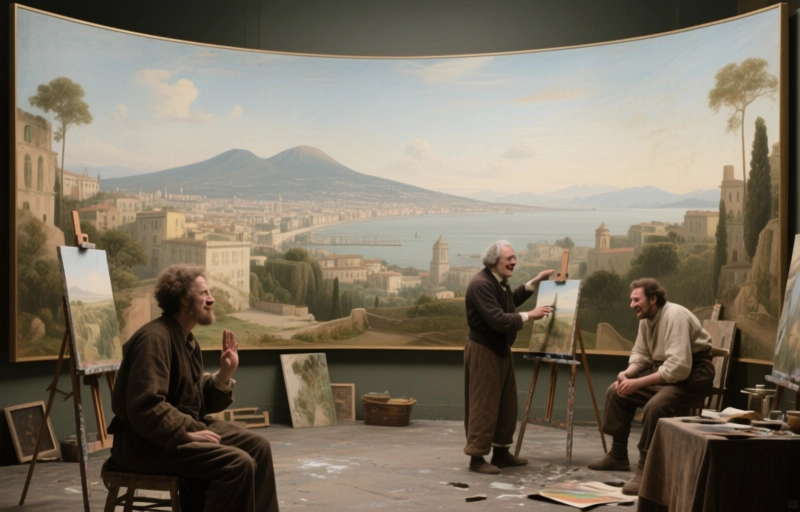
Explore the mysterious life and unique artistic vision of Jan van Stinemolen (1518–1582), the largely unknown creator behind the spectacular panoramic View of Naples.
Jan van Stinemolen (1518–1582) is one of those fascinating artists who somehow slipped through the cracks of art history. He's largely unknown today, which is surprising when you consider the spectacular work he left behind. We have to piece together his biography from scattered archival sources, because he doesn't even get a mention in Karel van Mander's famous *Schilder-Boeck*. What we do know paints a picture of a man moving between worlds—both geographically and professionally.
### Piecing Together a Fragmented Life
Those archival records primarily place Stinemolen in the Spanish Netherlands. He started in his hometown of Mechelen and later moved to Antwerp. The timeline gets fuzzy when we try to pin down his travels to Italy. We know he spent time in Naples and southern Italy—a trip to Sicily is hinted at in one of his drawings—but the exact dates are lost to us. It's like trying to complete a puzzle with half the pieces missing.
He likely followed the family trade, working primarily as a silversmith and jeweler. That was a prosperous profession in the 16th century, though the religious wars sweeping through his homeland probably disrupted his life and work. Here's the tragic part: not a single piece of his metalwork has survived. All that remains of his artistic output are a few drawings and one magnificent panorama.
### The Spectacular View of Naples
Apart from those handful of drawings, attributed to him mostly on stylistic grounds, we have his masterpiece: the *View of Naples*. This isn't just a simple cityscape. Stinemolen created something unique—a particular amalgamation of a topographical map and a perspectival view. It's both scientifically precise and artistically breathtaking.
Where did this innovative approach come from? It might have roots right in Mechelen. That city was a hub for urban cartography in the 16th century, a place where mapmaking flourished. Stinemolen would have been exposed to those techniques, and he brilliantly fused them with an artist's eye for composition and detail.
### An Artist Fascinated by Nature's Forces
Looking at his drawings, another theme emerges clearly. Stinemolen was captivated by landscapes shaped by volcanic forces. You can see this fascination in how he depicted terrain and geology. It wasn't just about recording what he saw; it was about understanding the powerful natural processes that created it.
This leads us to some interesting hypotheses about his artistic motivations. The characteristics of his Naples panorama suggest he wasn't just a craftsman. He had a deep interest in natural history, in how the world works. His art becomes a document of inquiry as much as a document of place.
Think about what that means. In an age before photography, an artist like Stinemolen was both a recorder and an interpreter of the world. His panorama of Naples does more than show us the city. It shows us how he saw the city—through the lens of cartographic precision and a genuine wonder at the natural world.
We're left with a handful of clues and one magnificent work of art. Stinemolen's story reminds us how many artists' lives are fragmented, known only through their surviving work. His *View of Naples* stands as a testament to a unique vision, blending science and art in a way that still feels fresh centuries later. It makes you wonder what else he created that we've simply lost to time.