Jan van Stinemolen: The Lost Artist Behind Naples'…
Miguel Fernández ·
Listen to this article~4 min
Explore the mysterious life of Jan van Stinemolen (1518–1582), the forgotten artist behind the spectacular panoramic View of Naples. Discover how his unique blend of cartography and perspective created a masterpiece.
Let's talk about Jan van Stinemolen. You've probably never heard of him, and honestly, that's not surprising. He's one of those fascinating artists who slipped through the cracks of art history. Living from 1518 to 1582, he created something spectacular—the panoramic View of Naples—yet his story remains a puzzle we're still piecing together.
Here's the thing about Stinemolen: he's completely absent from Karel van Mander's famous *Schilder-Boeck*, which was basically the who's who of 16th-century Netherlandish artists. That means we have to dig through old archives to find him, and even then, we only get glimpses. It's like trying to complete a jigsaw puzzle with half the pieces missing.
### Piecing Together a Fragmented Life
What we do know paints an interesting picture. The records show he was in the Spanish Netherlands, first in his hometown of Mechelen and later in bustling Antwerp. But here's where it gets murky—we're not entirely sure when he traveled to Naples and southern Italy. We can guess he went to Sicily because of one of his drawings, but the dates? They're lost to time.
Like others in his family, he was likely a silversmith and jeweller. That was a good, profitable trade back then, though the religious wars probably made life complicated. The irony is, none of his metalwork survives. All we have left are a handful of drawings and that one breathtaking panorama of Naples.
### The Spectacular View of Naples
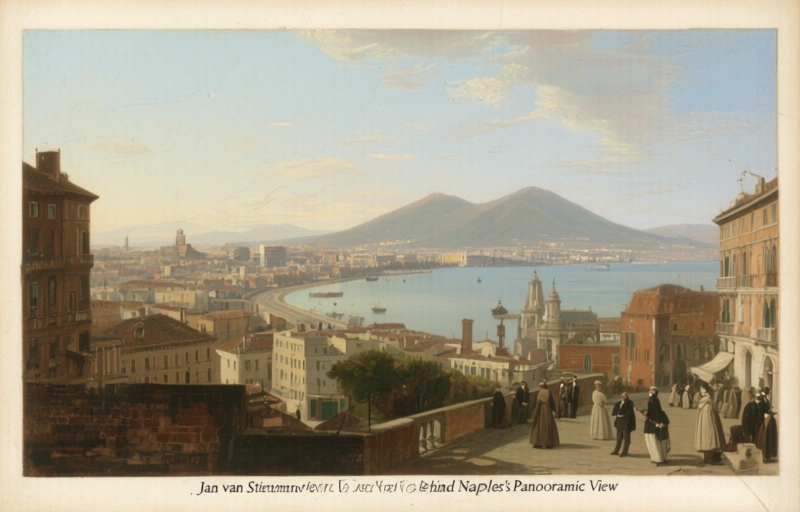
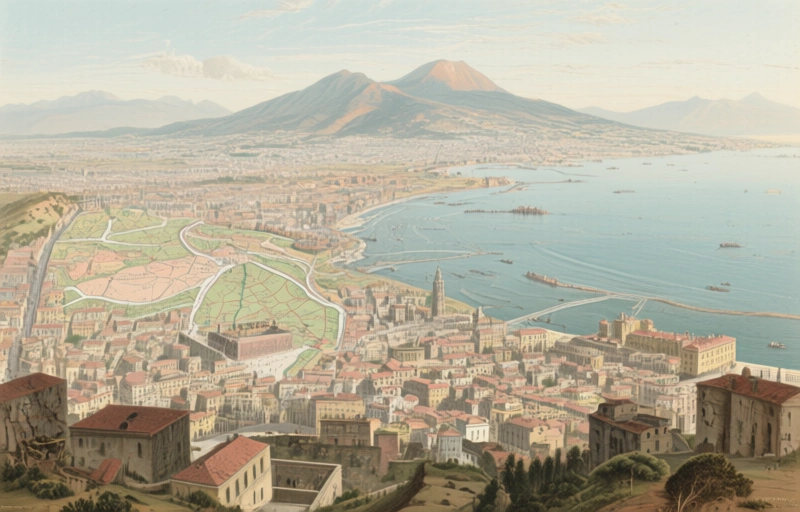
This isn't just any cityscape. Stinemolen's panorama is something special—a unique blend of topographic map and perspectival view. He wasn't just showing buildings; he was mapping the city while making you feel like you were standing there, taking it all in.
Where did this approach come from? Probably from Mechelen itself. In the 16th century, that city was a hub for urban cartography. Stinemolen would have grown up surrounded by people thinking about how to represent space, how to capture a city's essence on paper or canvas.
### An Artist's Fascination with Nature's Power
Look at his drawings, and you'll notice something—he was captivated by landscapes shaped by volcanic forces. There's a raw, powerful energy in how he depicted these natural formations. It wasn't just about pretty scenery; it was about understanding the forces that created the world around him.
This brings us to what might have driven Stinemolen creatively. The characteristics of his panorama let us make some educated guesses:
- He had a genuine interest in natural history
- He wanted to document the world scientifically
- He sought to blend artistic beauty with geographic accuracy
- He was fascinated by how humans interact with dramatic landscapes
Think about it—creating a panorama like this wasn't just technical skill. It required curiosity, patience, and a particular way of seeing the world. Stinemolen wasn't content with surface appearances; he wanted to understand the underlying structures, both natural and man-made.
### Why Stinemolen Matters Today
So why should we care about this mostly-forgotten artist? Because he represents all the creative voices history nearly erased. His story reminds us that art history isn't just about the famous names—it's about everyone who contributed to how we see and represent our world.
His panoramic view gives us a window into 16th-century Naples, yes, but it also shows us how one artist grappled with big questions. How do you capture a city's soul? How do you balance artistic vision with factual representation? How do natural forces shape human environments?
We'll probably never have Stinemolen's complete biography. Some mysteries stay mysteries. But what we do have—that spectacular panorama, those few surviving drawings—tells us enough to know he was someone worth remembering. Someone who looked at a city and saw not just buildings, but a story written in stone, water, and volcanic earth.