Jan van Stinemolen: The Lost Artist Behind Naples'…
Miguel Fernández ·
Listen to this article~4 min
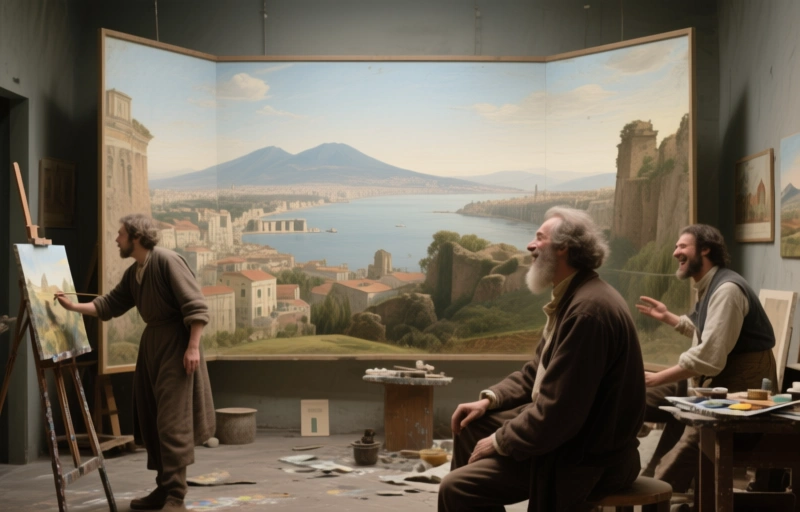
Explore the mysterious life of Jan van Stinemolen (1518–1582), the forgotten artist behind the spectacular View of Naples. Discover how this silversmith turned artist created a unique blend of mapmaking and perspective.
Jan van Stinemolen (1518–1582) is one of those fascinating artists who slipped through the cracks of art history. He's largely unknown today, and that's a real shame when you consider what little we do know about him. His story is like a puzzle with most pieces missing – we have to piece together his biography from scattered archival sources because he doesn't even appear in Karel van Mander's famous Schilder-Boeck, which was basically the who's who of 16th century artists.
### Piecing Together A Fragmented Life
What we do know paints an interesting picture. Stinemolen spent most of his life in the Spanish Netherlands, first in his hometown of Mechelen and later in Antwerp. But here's where it gets intriguing – we know he spent time in Naples and southern Italy, maybe even Sicily based on one of his drawings. The exact dates? Those are still unclear, lost to time. Like many in his family, he probably worked primarily as a silversmith and jeweler, which was a pretty prosperous trade back then. Though you have to wonder how the religious wars in his homeland affected his work and life.
### The Silversmith Who Became An Artist
Here's the frustrating part – none of his silversmith work has survived. Not a single piece. All we have left is his spectacular View of Naples and a handful of drawings that experts attribute to him based on style. It makes you think about all the beautiful objects he must have created that are just... gone. What's remarkable about his panorama of Naples is how he blended two different approaches:
- Topographical mapping (showing the actual layout of the land)
- Perspectival view (creating that three-dimensional, realistic look)
This unique combination might have roots in Mechelen, where urban cartography was really taking off during the 16th century. They were masters at mapping cities, and that influence seems to have stuck with Stinemolen.
### A Fascination With Volcanic Landscapes
Looking at his drawings, you can see he had this real fascination with landscapes shaped by volcanic forces. There's something about that raw, powerful natural creation that clearly captured his imagination. It wasn't just about pretty scenery – he was interested in how the earth itself creates art through eruption and transformation.
The characteristics of his panorama let us make some educated guesses about what drove him artistically. He wasn't just documenting a city – he was exploring something deeper about natural history and how humans interact with dramatic landscapes. There's a scientific curiosity there, mixed with artistic vision.
### Why His Story Matters Today
What I find compelling about Stinemolen is how he represents all those artists we've forgotten. The ones who didn't make it into the history books but still created meaningful work. His View of Naples isn't just a picture of a city – it's a window into how people in the 16th century saw and understood their world. It blends art, science, and personal observation in a way that feels surprisingly modern.
As one art historian put it, "Stinemolen's work reminds us that history is full of quiet masters whose stories we're still discovering."
We're left with questions we'll probably never answer. What was his daily life like in Naples? How did his training as a silversmith influence his drawing? What conversations was he having with other artists and thinkers of his time? The incomplete nature of his biography actually makes him more interesting in a way – we have to use our imagination to fill in the gaps.
For art professionals today, Stinemolen serves as a reminder that great work can come from unexpected places and people. His story encourages us to look beyond the famous names and consider all the artists whose contributions shaped our visual history, even if we don't know their full stories. That panoramic view of Naples isn't just a historical document – it's one man's unique vision, preserved against all odds.