Jan van Stinemolen: The Lost Artist Behind Naples'…
Miguel Fernández ·
Listen to this article~5 min
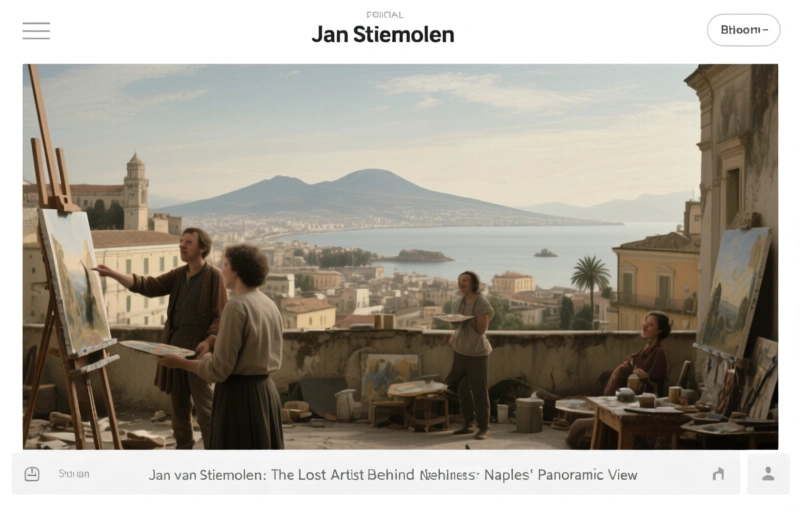
Explore the mysterious life and revolutionary panoramic art of Jan van Stinemolen (1518–1582), a Renaissance silversmith-turned-artist whose View of Naples blended cartography with artistic vision.
Jan van Stinemolen (1518–1582) is one of those fascinating artists who somehow slipped through the cracks of art history. He's largely unknown today, which is a real shame when you consider what little we do know about him. His story feels like a puzzle with half the pieces missing, and that's exactly what makes him so intriguing to art professionals like us.
We have to piece together his biography from scattered archival sources since he doesn't even get a mention in Karel van Mander's famous *Schilder-Boeck*. That's like being left out of the most important art directory of your time. What we do know paints a picture of a man moving between worlds – both geographically and professionally.
### The Journey of a Renaissance Craftsman
Stinemolen's trail starts in the Spanish Netherlands, first in his hometown of Mechelen and later in the bustling art center of Antwerp. But here's where things get fuzzy – we know he spent time in Naples and southern Italy, maybe even Sicily based on one of his drawings, but the exact dates? Those are lost to history.
Like other members of his family, he was probably primarily active as a silversmith and jeweller. That was a prosperous profession in the 16th century, though he likely faced challenges from the religious wars tearing through his homeland. The irony is, nothing survives of his metalwork – not a single piece. All we have are a few drawings and one spectacular work that changed how we see panoramic art.
### The Spectacular View of Naples
When you look at Stinemolen's *View of Naples*, you're seeing something revolutionary for its time. This isn't just a pretty picture – it's a particular amalgamation of topographical map and perspectival view that feels ahead of its time. The panorama captures the city with both artistic flair and cartographic precision.
Where did this innovative approach come from? Well, it might have roots right back in Mechelen, where urban cartography was flourishing in the 16th century. Stinemolen was essentially blending two disciplines that rarely spoke to each other – art and mapmaking.
What really stands out in his drawings is his fascination with landscapes shaped by volcanic forces. You can see it in the way he captures terrain – there's a geological awareness there that feels almost scientific. This wasn't just an artist painting what he saw; this was someone trying to understand how the natural world worked.
### Reading Between the Lines of History
The characteristics of his panorama let us form some interesting hypotheses about his artistic motivations. Here's what we can reasonably speculate:
- He had a genuine interest in natural history that went beyond surface observation
- His training as a silversmith might have influenced his attention to fine detail
- The blend of map and view suggests he saw art as documentation, not just decoration
- His travels through Italy exposed him to different artistic traditions he could synthesize
Think about it – in an age before photography, his panorama served multiple purposes. It was artwork, yes, but also a record of a place at a specific moment in time. For merchants, travelers, or even military planners, this kind of accurate representation had real practical value.
As one art historian noted, "Stinemolen's work bridges the gap between art and science in ways we're only beginning to appreciate."
### Why Stinemolen Matters Today
For art professionals, Stinemolen represents a fascinating case study in several ways. First, he reminds us how many artists' stories remain incomplete – how much art history is built on fragments and educated guesses. Second, his interdisciplinary approach feels remarkably modern, blending skills we usually keep in separate boxes today.
Most importantly, his work challenges our assumptions about Renaissance art. We tend to think of it in terms of famous names and major centers, but artists like Stinemolen were working in the spaces between – geographically between north and south Europe, professionally between craft and fine art, conceptually between observation and documentation.
His legacy, though small in terms of surviving works, opens up big questions about how we categorize artists and their contributions. Sometimes the most interesting stories aren't about the giants everyone knows, but about the talented figures working just outside the spotlight.