Jan van Stinemolen: The Lost Artist Behind Naples'…
Miguel Fernández ·
Listen to this article~5 min
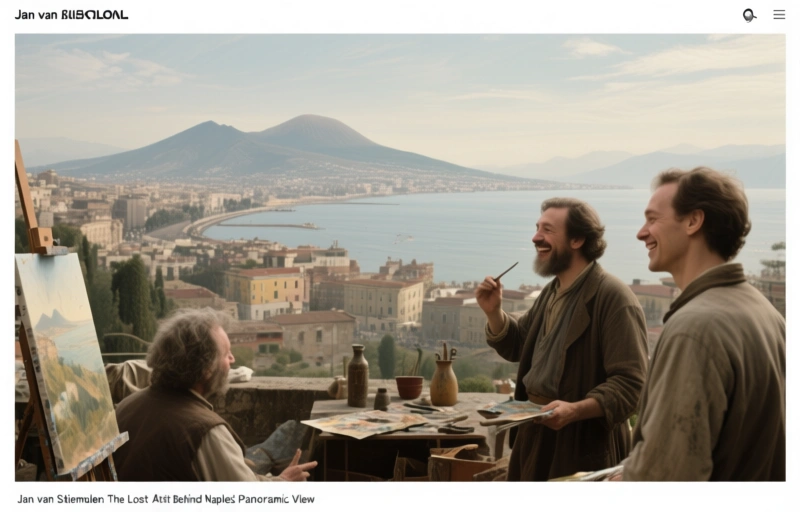
Explore the mysterious life and work of Jan van Stinemolen (1518–1582), the Renaissance artist behind the spectacular View of Naples. Despite being omitted from major art histories, his unique blend of cartography and perspective reveals a fascinating artistic vision.
Jan van Stinemolen (1518–1582) is one of those fascinating artists who slipped through the cracks of art history. He's largely unknown today, and honestly, that's a real shame. When you look at his work, you can't help but wonder how someone this talented didn't get more recognition in his own time.
Part of the problem is that Karel van Mander's famous *Schilder-Boeck* – basically the who's who of 16th century Netherlandish artists – doesn't mention him at all. So we're left piecing together his life from scattered archival records, and the picture that emerges is frustratingly incomplete.
### The Elusive Biography of a Renaissance Artist
What we do know is this: Stinemolen spent most of his life in the Spanish Netherlands. He started in his hometown of Mechelen, then moved to Antwerp – both major cultural hubs at the time. But here's where things get interesting. He definitely spent time in Naples and southern Italy, and we can even infer a trip to Sicily from one of his drawings. The exact dates? Those are still unclear.
Like other members of his family, he probably worked primarily as a silversmith and jeweler. That was a prosperous profession in the 16th century, though the religious wars sweeping through his homeland might have disrupted his work. The irony is that none of his metalwork has survived – all those intricate pieces, lost to time.
### The Spectacular View of Naples
What did survive is his spectacular *View of Naples*, along with a handful of drawings attributed to him on stylistic grounds. This panorama is something special – it's not just a pretty picture. Stinemolen created this unique blend of topographical map and perspectival view that feels both accurate and artistic.
Where did this approach come from? Well, it might have roots in Mechelen, where urban cartography was really flourishing in the 16th century. The city was known for its detailed city views and maps, so Stinemolen would have grown up surrounded by this tradition.
### Volcanic Landscapes and Artistic Motivations
Looking at his drawings, you can see he had this clear fascination with landscapes shaped by volcanic forces. There's something about the raw power of nature that seems to have captured his imagination. Maybe it was the contrast between human civilization and these unstoppable natural processes.
The characteristics of his panorama let us form some interesting hypotheses about what drove him artistically. Was he just documenting what he saw, or was there something deeper going on? Here are a few possibilities:
- He might have been interested in natural history, wanting to capture geological formations accurately
- His background in silversmithing could have influenced his attention to fine detail
- The blend of map and view suggests he valued both scientific accuracy and aesthetic appeal
- His travels through Italy exposed him to different artistic traditions he could synthesize
### Why Stinemolen Matters Today
Here's the thing about artists like Stinemolen – they remind us that history isn't just about the famous names we all know. There were countless talented people creating remarkable work who, for various reasons, didn't make it into the mainstream narrative of their time.
His story is a puzzle with missing pieces, and that's actually part of what makes it compelling. We have to read between the lines, look at the work that survived, and try to understand the person behind it. As one art historian noted, "Sometimes the most interesting stories are the ones we have to reconstruct from fragments."
What's remarkable is how much we can still learn from someone whose biography is incomplete. His *View of Naples* isn't just a historical document – it's a window into how one artist saw the world, blending observation with imagination, science with art.
For professionals studying Renaissance art, Stinemolen represents an interesting case study in cross-cultural exchange. Here's a Netherlandish artist traveling to Italy, absorbing what he sees, and creating something that reflects both his northern European training and his southern European experiences.
We're left with questions, of course. What other works did he create that haven't survived? How did his silversmithing influence his drawing? What conversations was he having with other artists during his travels? The gaps in our knowledge are invitations to keep looking, keep researching, and keep appreciating these lesser-known figures who contributed to our cultural heritage.