Jan van Stinemolen: The Lost Artist Behind Naples'…
Miguel Fernández ·
Listen to this article~4 min
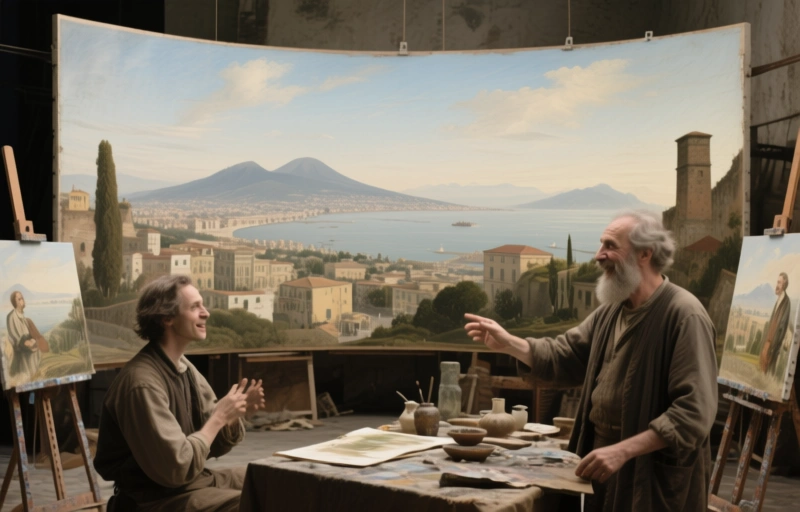
Explore the mysterious life and innovative art of Jan van Stinemolen (1518–1582), the silversmith-turned-artist behind the spectacular panoramic View of Naples.
Jan van Stinemolen (1518–1582) is one of those fascinating artists who somehow slipped through the cracks of art history. He's largely unknown today, which is a real shame when you consider what little we do know about him paints such an intriguing picture. His absence from Karel van Mander's famous *Schilder-Boeck* means we have to play detective, piecing together his life from scattered archival clues. The result is a biography full of gaps, but those gaps are where the mystery—and the interest—truly lies.
### Piecing Together a Fragmented Life
What we know for sure is that Stinemolen was present in the Spanish Netherlands. He started in his hometown of Mechelen and later moved to Antwerp. The timeline gets fuzzy when we try to pin down his travels to Italy. We know he was in Naples, and a drawing suggests he may have ventured to Sicily, but the exact dates? They're lost to time. It's like trying to follow a trail that's been partially washed away.
He likely followed his family's trade, working primarily as a silversmith and jeweler. That was a prosperous path in the 16th century, a solid, respectable craft. But his career unfolded against the turbulent backdrop of the religious wars, events that undoubtedly touched his life and work, even if we can't see exactly how.
Here's the cruel twist: not a single piece of his metalwork survives. All that remains of his artistic output is a handful of drawings and one spectacular masterpiece.
### The Spectacular View of Naples
That masterpiece is the *View of Naples*, a panoramic depiction that stands as his lasting legacy. It's not just a pretty picture; it's a unique hybrid. Stinemolen brilliantly fused the accuracy of a topographical map with the immersive feel of a perspectival view. You get the lay of the land and the sensation of standing there, all at once.
Where did this innovative approach come from? We can look to his roots. Mechelen was a hub for urban cartography in the 1500s. It's not a stretch to think that the detailed, map-making culture of his hometown directly influenced how he saw—and drew—the world.
His other drawings reveal another passion: a deep fascination with landscapes shaped by volcanic forces. This wasn't just an artist sketching scenery; this was a mind curious about the raw power of nature and how it sculpts the earth.
- **A Lost Craft:** His primary profession as a silversmith is confirmed by records, but we have zero examples of this work.
- **A Hybrid Vision:** The *View of Naples* merges map-making precision with an artist's eye for perspective.
- **Natural Curiosity:** His drawings show a specific interest in volcanic geology, hinting at broader scientific interests.
### Reading Between the Lines of His Art
So, what does this all tell us about Jan van Stinemolen the man? The characteristics of his panorama let us form some educated guesses. That blend of cartography and artistry suggests a uniquely analytical yet creative mind. He wasn't just recording; he was interpreting and synthesizing.
His focus on volcanic landscapes points to an interest in natural history, a man who was likely as much a student of the world as he was an artist or craftsman. One art historian noted, "His work sits at the crossroads of art, science, and craft, a testament to the Renaissance spirit."
We're left with a compelling puzzle. A successful silversmith, an innovative draftsman, a traveler between the North and South of Europe. His story is fragmented, but the fragments we have are gold. They point to an artist motivated by a desire to understand and document the world in all its complexity—from the precise layout of a city to the awesome force of a volcano. He reminds us that history is full of quiet masters waiting to be rediscovered.