Jan van Stinemolen: The Lost Artist Behind the Naples…
Miguel Fernández ·
Listen to this article~4 min
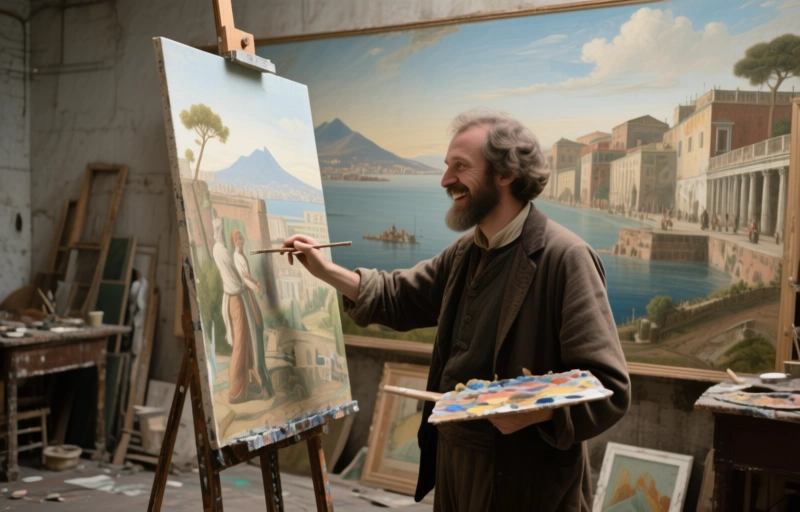
Explore the mysterious life of Jan van Stinemolen (1518–1582), a Renaissance silversmith and artist known only for his spectacular hybrid panorama, the View of Naples.
Let's talk about an artist who's slipped through the cracks of history. Jan van Stinemolen lived from 1518 to 1582, and honestly, most people have never heard of him. That's because he doesn't even get a mention in Karel van Mander's famous *Schilder-Boeck*, which was basically the who's who of 16th-century artists. So piecing together his life? It's detective work, plain and simple.
We're working with scattered archival records, and the picture is still incomplete. What we do know paints an interesting story of movement and craft.
### The Journey of a Renaissance Craftsman
Those records show Stinemolen moving through the Spanish Netherlands. He started in his hometown of Mechelen and later settled in Antwerp. But here's where it gets fuzzy—his time in Italy. We know he was in Naples and southern Italy at some point. One of his drawings even hints at a trip to Sicily. The exact dates, though? They're lost to time.
Like others in his family, his main trade was likely silversmithing and jewelry. That was a lucrative business back then, a real path to prosperity. Of course, living through the religious wars in the Netherlands couldn't have been easy, and that turmoil probably touched his life and work. The frustrating part? Not a single piece of his metalwork survives today.
### The Spectacular View of Naples
So what *do* we have from him? Almost nothing, except for one remarkable piece: the spectacular *View of Naples*. Beyond that panorama, only a handful of drawings remain, attributed to him mostly because of their style.
This is what makes Stinemolen so fascinating. His *View of Naples* isn't just a pretty picture. It's a unique blend—a hybrid that merges a detailed topographical map with a sweeping perspectival view. You're looking at a map and a painting at the same time. Where did this innovative approach come from?
### Roots in Mechelen's Cartographic Tradition
The answer might lie back in Mechelen. In the 16th century, that city was a hub for urban cartography. Map-making was flourishing there. It's very possible Stinemolen absorbed these techniques and later fused them with an artist's eye for perspective. He wasn't just recording a city; he was presenting it as an experience.
Look at his other drawings, and another passion becomes clear: a deep fascination with landscapes shaped by volcanic forces. You can see the drama of nature's power in his work. This interest in natural history seems to drive his artistic vision. The characteristics of his great panorama let us build hypotheses. Was he driven by scientific curiosity? An artistic challenge? A merchant's desire to document a trading port? Probably a mix of all three.
- **A Missing Biography:** His story is incomplete, assembled from fragments.
- **A Dual Career:** He was likely a prosperous silversmith, but none of that work remains.
- **A Hybrid Masterpiece:** The *View of Naples* combines map-making and artistic perspective.
- **A Naturalist's Eye:** His drawings reveal a fascination with volcanic landscapes.
As one scholar might note, "Stinemolen's work sits at the crossroads of art, science, and commerce, a testament to the Renaissance spirit."
In the end, Jan van Stinemolen remains an enigma. A successful craftsman whose primary trade has vanished. An artist with a single major surviving work that continues to captivate us. His panorama is more than a view; it's a window into how one man saw the world—part cartographer, part artist, entirely unique. He reminds us that history is full of brilliant minds whose stories are waiting to be rediscovered, one clue at a time.