Jan van Stinemolen: The Lost Artist Behind Naples' Panorama
Miguel Fernández ·
Listen to this article~4 min
Explore the mysterious life and singular masterpiece of Jan van Stinemolen (1518–1582), the silversmith-turned-artist whose panoramic View of Naples blends mapmaking with artistic vision.
Let's talk about an artist who's been hiding in plain sight. Jan van Stinemolen lived from 1518 to 1582, and honestly, most people have never heard of him. That's because he wasn't mentioned in the big art history books of his time, like Karel van Mander's *Schilder-Boeck*. So piecing together his life is like solving a puzzle with half the pieces missing.
We know he was from the Spanish Netherlands, starting in Mechelen and later moving to Antwerp. But here's where it gets fuzzy—his time in Naples and southern Italy is a mystery. We think he went to Sicily because of one drawing, but the dates? They're completely unclear.
### The Silversmith Who Painted
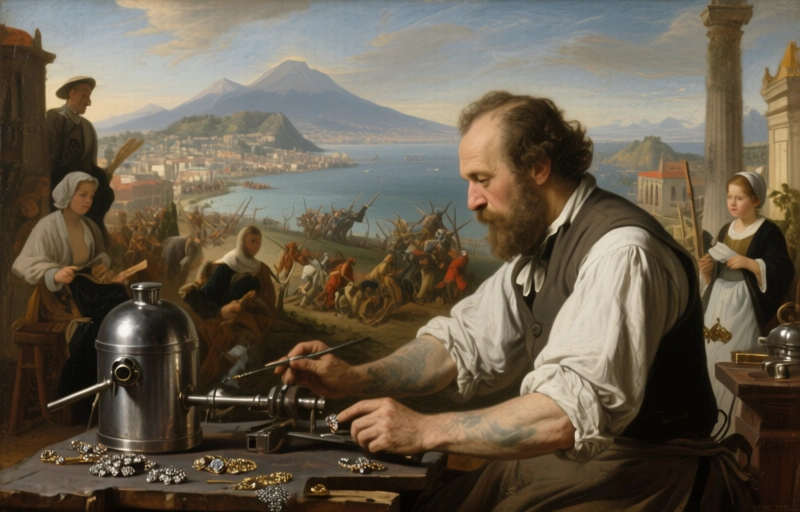
Like others in his family, Jan probably made his living as a silversmith and jeweler. That was a good trade back then, a real moneymaker. But the religious wars in his homeland might've thrown a wrench in his plans. The crazy part? None of his metalwork survived. Not a single piece.
What we do have is his spectacular *View of Naples* and a handful of drawings. Most of those drawings are attributed to him because they just *look* like his style. That's how art historians work sometimes—they connect the dots based on what feels right.
### A Map That's Also a Painting
Stinemolen's panorama of Naples is something special. He mashed up a topographical map with a perspectival view, creating something that's both accurate and beautiful. Where'd he get that idea? Probably from Mechelen, where urban cartography was booming in the 1500s.
He was clearly fascinated by landscapes shaped by volcanic forces. You can see it in his drawings—the raw power of nature captured on paper. His panorama isn't just pretty; it's a document that lets us guess at what drove him artistically and why he cared about natural history.
### Why He Matters Today
Think about it—here's an artist who worked in a profitable trade but left us only fragile works on paper. His metal creations, the ones that probably paid his bills, are gone forever. What survived was his vision of a city, drawn with a mapmaker's precision and an artist's eye.
- His biography is incomplete, built from scattered records
- His journey to Italy remains poorly documented
- His primary profession left no physical evidence
- His artistic legacy rests on one major work and a few attributed drawings
That's the thing about history—it doesn't always preserve what we expect. The durable metals vanished while the delicate drawings endured. Stinemolen reminds us that sometimes the most lasting things aren't the most practical ones.
His work sits at this interesting crossroads between art and science, between documenting a place and interpreting it. In an age before photography, his panorama showed Naples in a way that was both informative and inspiring. He wasn't just recording what he saw; he was telling us how to see it.
So next time you look at an old map or a cityscape painting, remember artists like Jan van Stinemolen. They were the original content creators, making sense of their world one drawing at a time. And sometimes, like Jan, they do it so well that we're still talking about them centuries later, even when most of their story is lost to time.