Jan van Stinemolen's 1582 Naples View: Nature and Urban Form
Miguel Fernández ·
Listen to this article~3 min
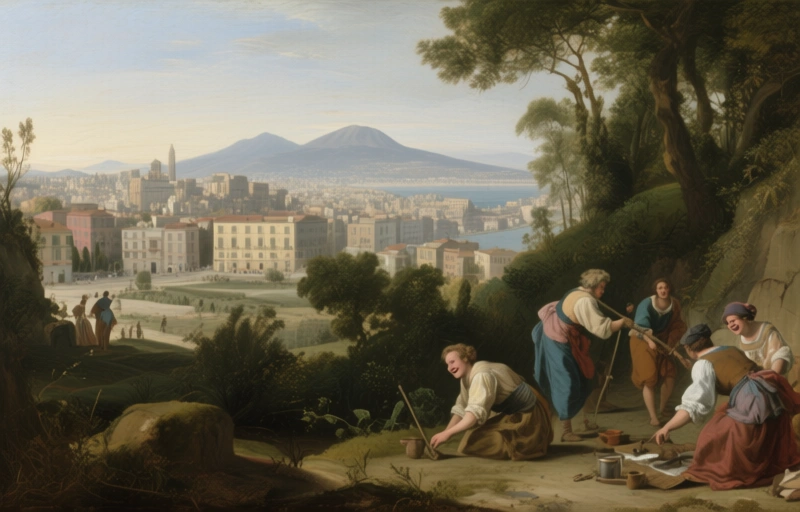
Jan van Stinemolen's 1582 view of Naples offers an unusual hillside perspective, emphasizing the city's relationship with its volcanic landscape and raising intriguing questions about its symbolic architecture.
Let's talk about a map that makes you see a city differently. In 1582, artist Jan van Stinemolen didn't just draw Naples. He captured its soul, embedded in the dramatic landscape between Vesuvius and the Phlegraean Fields.
Most maps of the time were flat, practical things. Stinemolen chose a hillside perspective, looking down toward the gulf. This wasn't just artistic flair. It was a statement. It forced the viewer to see the city as part of a grander, wilder natural system.
### The Unusual Perspective
That elevated viewpoint changes everything. You don't just see streets and walls. You see how the city nestles into the terrain. You feel the looming presence of the volcano and the sprawling volcanic fields. Nature isn't a backdrop here. It's a central character, both outside and, surprisingly, inside the city's defenses.
This leads us to the first big puzzle. The fortifications Stinemolen shows don't match the historical record of Viceroy Pedro de Toledo's walls. The form is different. The connection to the northwestern urban areas is off. Scholars have long debated this 'topographical truth.' Was he just wrong?
### The Mystery of the Monumental Gate
Maybe not. Let's start with a specific detail: the gate. Stinemolen depicts a grand, monumental gate facing the viewer. Yet, historical sources say that spot only had a minor opening, a *pertuso*. The actual grand gate, Porta Medina, wasn't built until sixty years later.
So why invent a gate? It might be intentional. This seemingly inconsistent feature actually aligns with the imagery of ancient, venerable towns. By adding an imposing gate, Stinemolen could have been evoking Naples's classical past, suggesting antiquity and permanence. He wasn't just recording; he was interpreting the city's essence.
### Reading the Bedrock
Now, look closer at the ground. Stinemolen pays extraordinary attention to the bedrock. Its texture, its variation, its very presence is rendered with care. This wasn't standard practice. Through this view and his other drawings, we see an author fascinated by the natural phenomena unique to the Neapolitan region.
This emphasis parallels a growing intellectual movement of the time. A rising naturalist interest in volcanic phenomena was taking hold. Stinemolen's drawing can be seen as part of that narrative. He's visually documenting the volcanic foundation upon which the city was literally built.
- **Key Takeaway 1:** The view prioritizes environment over isolated urban detail.
- **Key Takeaway 2:** Architectural 'inaccuracies' may be symbolic, linking Naples to an ancient ideal.
- **Key Takeaway 3:** The detailed bedrock reveals a proto-scientific interest in geology and volcanism.
In the end, Stinemolen's 1582 view is more than a map. It's a layered document. It's a landscape painting, a historical commentary, and an early scientific observation all in one. It asks us to consider how we represent places. Do we show only what's there, or do we show what a place *means*? His work suggests that sometimes, to tell the deepest truth, you have to look from a different angle—and maybe even add a gate that wasn't quite there yet.